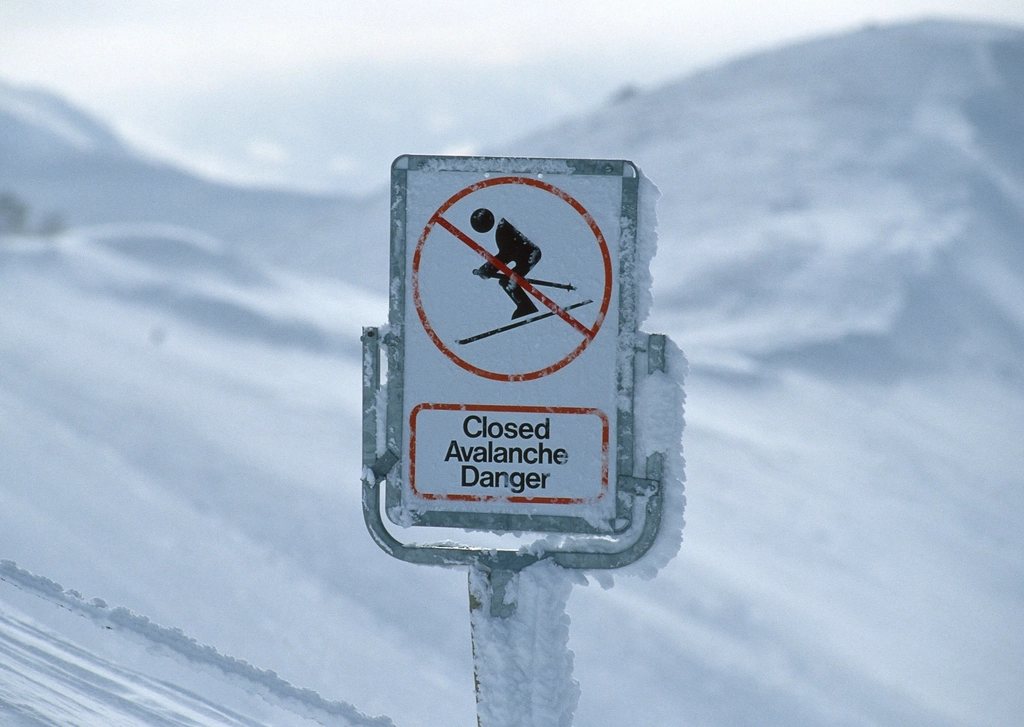
Most of the avalanche decisions we make in a season happen at a kitchen table, not on a ridge. By the time we are standing on top of a slope, tired and cold and looking at untracked snow, the honest part of our judgement has already been spent. The forecast is where the real thinking happens, and learning to read it properly is the single most useful skill a new backcountry skier can build. It is free, it takes ten minutes, and it is written by people who have spent the night thinking about exactly the snow we are about to ski.
The danger scale is not linear
Public avalanche forecasts in North America and Europe use a five-level danger scale: 1 Low, 2 Moderate, 3 Considerable, 4 High and 5 Extreme. The numbers look evenly spaced, but the risk they describe is not. Each step up roughly doubles the likelihood and the size of avalanches. Low means natural avalanches are unlikely and human-triggered ones are unlikely except in isolated features. Considerable means natural avalanches are possible and human-triggered avalanches are likely on specific terrain. High means they are likely and often large, and travel in avalanche terrain is not recommended at all.
The level that catches the most people is 3, Considerable. It is the most common rating on a winter day in many ranges, and long-term accident statistics from the Alps and the Rockies consistently show that around half of fatal accidents happen under it. It is a rating that still permits skiing, which is exactly why it demands the most careful terrain selection.
Problems, not just numbers
A single number for a whole mountain range is a blunt tool, so modern forecasts describe avalanche problems: what kind of instability exists, where it sits and how it behaves. Four of them account for most of what we meet in winter and early spring.
A storm slab is new snow that has fallen fast enough to form a cohesive layer over an older surface. It is usually most reactive in the 24 to 48 hours after a storm, and it tends to stabilise quickly as the new snow settles and bonds. Wind slab is snow that has been picked up by the wind and deposited on lee slopes, often as a dense, hollow-sounding pillow just below ridgelines and behind terrain features. It can form without any new snowfall, and it is found on the aspects opposite to the prevailing wind. A persistent slab sits on a buried weak layer, most often surface hoar, faceted snow or a crust with facets beneath it. It can stay reactive for weeks and produce large avalanches long after the last storm, sometimes triggered from flat ground below the slope. Wet loose avalanches start at a point and fan out downhill, usually when sun or warm air melts the surface snow; they are common on sunny aspects in the afternoon and after rain.
Each problem in a forecast comes with a likelihood, an expected size and a set of aspects and elevations where it is found. Reading those together tells us what kind of terrain is a poor idea today, not just how worried to be in general.
Aspect and elevation bands
Forecasts divide the mountain into three elevation bands: alpine, above the trees; treeline, the transition zone where the forest thins; and below treeline. Wind slabs live mostly in the alpine and at treeline, because that is where the wind has room to move snow. Persistent weak layers are often worst on shaded north-facing slopes at treeline and above, where cold, calm nights let facets and surface hoar grow. Wet problems favour east, south and west aspects that receive direct sun.
The aspect rose in a forecast, a wheel showing eight compass directions across three elevation bands, is the part we spend the longest on. If the shaded segments show a persistent slab on north through east at treeline and above, then a sheltered north-east bowl at 2,300 metres (7,500 feet) is precisely the wrong place to be, however inviting the powder looks from the col.
Where slopes actually slide
Slab avalanches release on slopes between about 30 and 45 degrees, with the greatest frequency around 35 to 40 degrees. Below 30 degrees the snow rarely carries enough stress to fracture as a slab; above 45 degrees, snow tends to sluff off continuously in small amounts rather than building into a dangerous slab. Most of the terrain that is fun to ski sits squarely inside that band, which is why we carry an inclinometer and use it, and why we look not only at the slope under our skis but at the steeper terrain above and beside us that connects to it.
The slope angle also has to be read together with what lies below. A 32-degree glade that runs out into a flat meadow is a different proposition from the same angle above a gully, a cliff or a creek bed. Terrain traps turn small avalanches into deep burials.
ALPTRUTh: seven questions
A simple checklist developed from a large study of accidents in the United States helps turn all of this into a decision. The acronym is ALPTRUTh, and each letter is a yes-or-no question.
- Avalanches: have there been avalanches in the last 48 hours?
- Loading: has there been new snow, rain or wind transport in the last 48 hours?
- Path: is the slope an obvious avalanche path?
- Terrain trap: are there gullies, trees, cliffs or a flat runout where debris piles up?
- Rating: is the danger rated Considerable or higher?
- Unstable snow: have we seen cracking, collapsing, whumpfing or recent slab avalanches?
- Thaw: has there been recent warming, sun or rain on the slope?
In the accident data, most fatal slides happened with three or more of these factors present. The checklist is not a substitute for a course or for experience, but it is an honest way of noticing when several small warnings have quietly stacked up.
When the forecast says stay home
There is a particular kind of day when the forecast is doing everything it can to keep us off the mountain. The rating is High. There is a persistent slab problem listed on all aspects, with large avalanches likely. The discussion mentions remote triggering, or avalanches running to the valley floor. On those days we do not go looking for a safe line on a low-angle slope, because the runouts and the approaches are the problem, and because the forecaster is writing with information we do not have. We ski groomed runs, or we go for a walk, and the snow will still be there when the layer has healed. The forecast only works if we are willing to hear no.