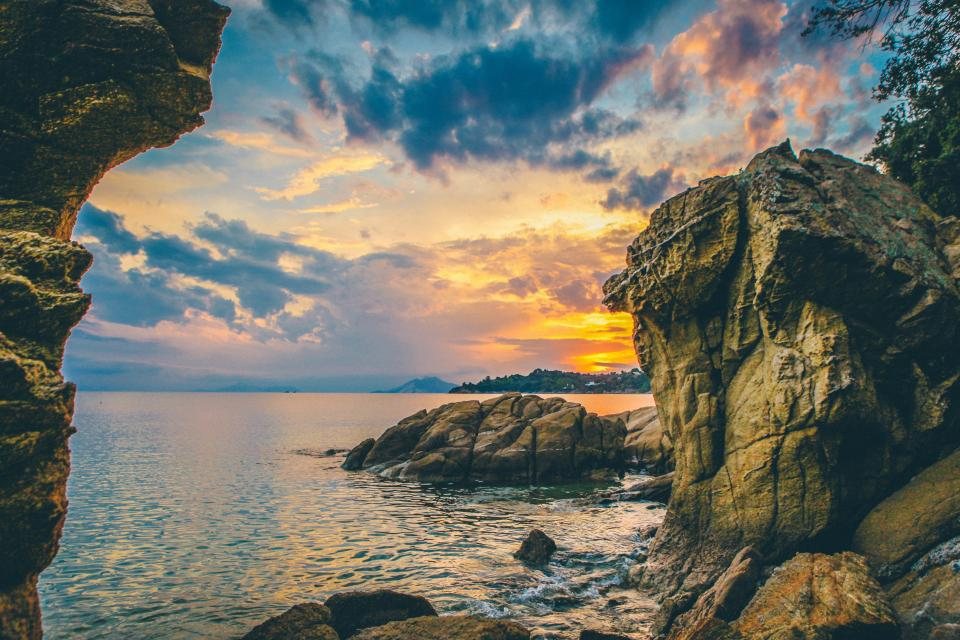
Some destinations are good for one thing. Kalymnos, a small rocky island in the Dodecanese group of the eastern Aegean, is good for almost all of them. It has steep limestone caves dripping with tufas, gentle slabs for a first week outside, sea views from every belay, a village built around climbers, and a rest-day culture that would justify the trip on its own.
How a sponge-diving island became a climbing island
For most of its history Kalymnos lived from the sea. Its sponge divers were famous across the Mediterranean, and the harbour town of Pothia still shows that wealth in its tall painted houses. Climbing arrived late. In the second half of the 1990s a small group of Italian climbers bolted the first routes on the walls above Massouri, and the local authorities, unusually for the time, saw the potential and supported development instead of resisting it. Within a decade the island had a few thousand routes, an annual climbing festival, and a steady stream of visitors filling the low season that tourism had left empty.
Today the route count is somewhere above three thousand, spread over more than eighty sectors on the main island and on Telendos, the smaller island across the strait. New sectors still appear every year, and an active rebolting programme replaces older hardware with glue-in anchors that resist the salty air far better than the original bolts did.
The rock: tufas, pockets and grey slabs
The limestone on Kalymnos comes in two moods. In the caves and on the overhanging walls, water running down the rock over long periods has left tufas: vertical ribs, columns and curtains of calcite that you pinch, hug and sometimes knee-bar. The Grande Grotta above Massouri is the most famous example, a huge amphitheatre of stalactites where the routes lean out so far that the last bolt can hang ten metres from the base. The climbing there is physical and three-dimensional, and the classic lines in the low 7s attract queues in peak season for good reason.
Away from the caves the rock turns grey and vertical, with sharp pockets and edges. Sectors like Odyssey, Arhi, Spartacus and Poets offer dozens of routes between 5a and 6c on rock that stays textured and clean. This is where most visiting climbers spend most of their time, and it is the reason the island works for mixed-ability groups. A party where one person climbs 7b and another is happy on 5c can share a sector, and often a belay ledge, without anyone compromising.
Route lengths vary from short twenty-metre pitches to rope-stretching forty-metre lines. A seventy-metre rope is the sensible minimum, and an eighty covers the longer routes in the caves. Most sectors are single pitch, but several multi-pitch routes exist on Telendos and on the bigger walls to the north, with five to eight pitches of moderate climbing and an unbeatable position above the water.
Massouri as a base, and getting around
Massouri sits on the west coast directly under the main cliffs, and it is where nearly everyone stays. Guesthouses and small studio apartments line the road, and many owners cater specifically for climbers, with drying racks, early breakfasts and route information at the desk. The neighbouring village of Myrties, a short walk south, is quieter and has the small boat taxi across to Telendos.
The classic way to move around is a rented scooter. The island is small, the roads are mostly good, and the sectors north and south of Massouri are five to twenty minutes away by bike. Approaches from the parking spots are generally short: ten to thirty minutes on marked footpaths that climb steeply through thorny scrub. A few sectors are longer, up to an hour, and the walk in the morning shade is part of the day. A local bus and taxis are the alternative, at the cost of some flexibility.
Getting to the island takes a little planning. The small airport handles limited flights, so most visitors fly to the neighbouring island of Kos and take the ferry from its north coast, a crossing of roughly half an hour to Pothia or to a smaller harbour further north.
Seasons: spring and autumn, not summer
Kalymnos is a two-season destination. Spring, from roughly March to May, brings green hillsides, wild flowers, mild days and occasional showers. Autumn, from September to early December, is drier and warmer at the start, cooling steadily into late November. Both seasons give comfortable temperatures for climbing in the shade and the sea is still warm enough to swim in during autumn.
Summer is a different story. From June to August the heat makes daytime climbing miserable, and only the deepest caves and the earliest hours are workable. Winter is possible and quiet, with some rain and shorter days, but many restaurants and rental shops close and the tufa caves can seep after wet spells. If you want the island at full strength, come in October or April.
The sun matters as much as the season. Most of the Massouri cliffs face west and get sun from around midday, so the routine is to climb in the morning shade, take a long lunch, and return in the late afternoon or move to an east-facing sector. Check the aspect of each sector before you commit to a full day there.
Rest days and the rest of the island
A trip to Kalymnos is rarely just climbing. Rest days fill themselves easily with the following:
- A boat ride across to Telendos for a swim from the small beaches and a quiet lunch on the waterfront.
- The walk up to the ruined castle above Pothia, with views across the whole island and to the Turkish coast.
- The narrow inlet of Vathy on the east coast, where a valley of citrus groves ends in a tiny harbour.
- The sponge museum and the market streets of Pothia, best visited early before the heat.
Food is simple and good: grilled fish, slow-cooked goat, local honey and the small island cheeses.
Practical notes before you go
Bring twenty quickdraws, a rope long enough for the sector you have in mind, and a stick clip for the steeper starts. The bolting is generally generous, but tufa climbing often puts the clip in an awkward place, so practise clipping from a knee-bar before you need to. Helmets are worth wearing in the caves, where loose flakes come off the roof after rain. Respect the goat fences and gates on the approaches, take your rubbish down with you, and remember that the island’s water supply is limited. Kalymnos has given climbers a great deal. It is fair to leave it as we found it.
Read next: Downturn Climbing Shoes: Choosing the Right Angle for Your Style