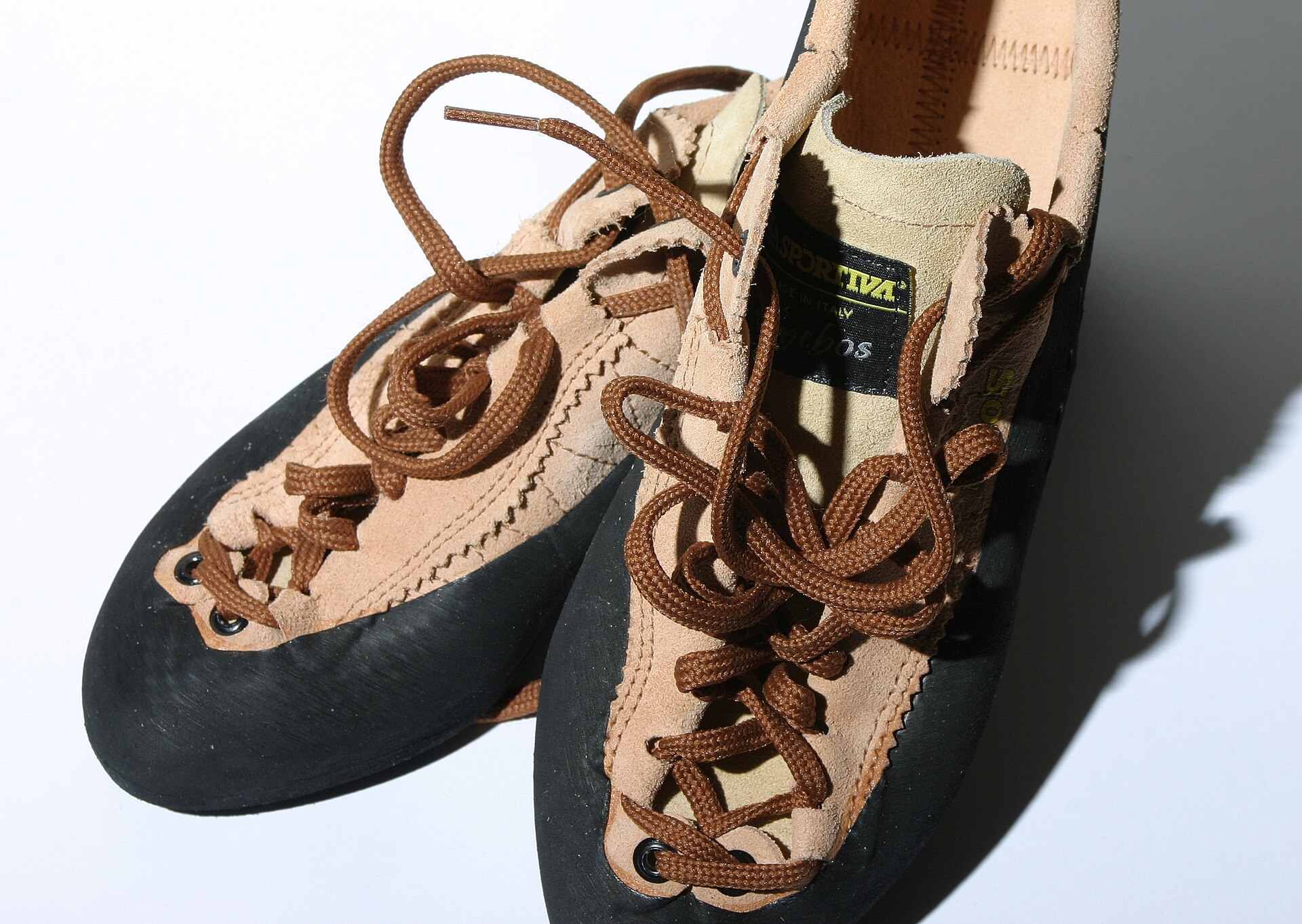
Downturn is the curve that pulls a climbing shoe’s toe below the heel. It changes how your weight reaches the rock, how long your feet last, and which terrain a shoe suits. This guide explains the mechanics first, then shows how to match a profile to your climbing.
- Downturn concentrates force on the big toe, which helps on steep ground and costs comfort everywhere else.
- Profiles run from neutral to moderate to aggressive, and each fits a different kind of route.
- Fit, rubber and patience matter as much as the curve itself.
What does downturn actually do to your feet?
A downturned shoe holds your foot in a slightly flexed, claw-like shape. The reason this matters is leverage. Instead of resting flat on a hold, your toes are already pointed toward the rock, so the shoe behaves like an extension of a gripping hand.
The curve is usually paired with an asymmetric last, which bends the shoe toward the big toe. Together, these features send your push through that one toe. That is why aggressive shoes feel so precise on small footholds: the force goes exactly where you place it, rather than spreading across the forefoot.
The same shape explains the discomfort. Your toes stay curled, the heel is held under tension, and the foot has no chance to relax. Think of downturn as a tool that trades endurance for focus.
How do neutral, moderate and aggressive profiles differ?
Shoe makers commonly sort models into three profiles. Understanding what each is built for saves you from buying the wrong one.
Neutral
A neutral shoe has a flatter sole, so the foot rests close to its natural position. It is the comfortable choice for beginners and for long days, including longer routes where you want your feet to survive the whole outing.
Moderate
A moderate shoe adds a cambered toe box, a slightly curved shape. It usually pairs this with a thinner sole and stickier rubber than a neutral model. That combination makes it the flexible middle ground for slab, cracks, gentle overhangs and multi-pitch climbing.
Aggressive
An aggressive shoe has a strong downturn and heel tension, with the asymmetric shape that loads the big toe. It is usually the most painful to wear, and it is built for steeper terrain where precise foot pressure and sensitivity decide whether a move works.
Note that the profile describes a shape, not an exact angle you can compare across brands. Treat any degree figure on a shoe as a rough guide and judge the shoe on your own foot.
Which terrain suits a strong downturn?
Steepness is the deciding factor. On overhanging ground, a curved shoe lets you pull on holds with your feet, which helps you keep your toes engaged and stay tight to the wall. Being able to pull rather than merely stand reduces the chance that a foot cuts loose, and it can save arm energy.
Aggressive shoes also help with heel hooks, because the shape encourages a pointed toe and gives the heel a snug pocket. Toe rubber on top of the shoe supports toe hooks, where the top of the foot grips a feature.
On slabs and vertical ground the case reverses. There, a flatter shoe gives a stable platform and encourages clean footwork, so a heavily curved model is working against you. Flat shoes also suit cracks and long routes where comfort carries the day.
A practical way to choose is to ask what you climb most. Mostly steep boulder problems or hard overhanging routes point toward more curve. A mix of terrain, or long days, points toward something moderate.
How should you size, break in and manage rubber?
Fit should be tight but not painful. Your toes sit at the front of the shoe, which stops the foot from sliding and lets you transmit force. A shoe that is too loose wastes the whole point of the design, because the foot shifts and precision disappears.
Be careful with the urge to downsize aggressively. Some uppers stretch, and leather in particular can give, so a shoe that feels merely snug in the shop may loosen with use. Unlined leather stretches more than lined leather, which is worth knowing before you decide how tight to go. The opposite mistake also exists: pushing a pointed, curved shoe too small can compress the foot, and long-term overly tight shoes have been linked with foot problems. Pain that does not ease is a signal to change size or model, not to endure it.
Closures shape the experience too. Laces give the most adjustment, which helps if you want to loosen for an approach and tighten for a hard move. Velcro is quicker to take on and off but less precise. Slip-ons give a very close fit but must be sized correctly so the foot does not move inside.
On rubber, there is a trade-off between stickiness and durability. Softer, stickier compounds perform better but wear out faster. Thinner soles add sensitivity, while stiffer ones support your toes on edges. Choose according to whether you value feel or support for the terrain you climb.
How do you choose, and how do you use a curved shoe well?
Start from your climbing, not from the most aggressive shoe on the wall. If you are new, a comfortable, flatter shoe is usually the better first pair, because the benefits of a curved shoe depend on skills you build over time, such as climbing steep ground and pulling on small edges with your toes.
If you already climb steep terrain, consider owning two pairs. A curved shoe for short, hard efforts and a flatter one for warm-ups and long days is a common solution. Curved shoes tend to work best in short bursts, so take them off between attempts rather than wearing them all session.
- Match the curve to the steepest terrain you climb regularly.
- Prefer comfort for long routes and for learning footwork.
- Try shoes on both feet and judge them after several minutes, not seconds.
- Expect a tight fit, but treat sharp or lasting pain as a reason to reconsider.
Cost matters as well. Specialised shoes tend to be pricier, so it makes sense to commit to one only once you know which style of climbing you keep returning to.
Related reading
- Desert Granite Dreams: A Climber’s Journey Through Utah
- El Chorro and the Caminito del Rey: Winter Sun Climbing in Andalusia
Sources
- Climbing shoe — Wikipédia (en.wikipedia.org, accessed 2026-11-04)
Photo: Climbing shoe la sportiva mythos 01, by akeg, CC BY-SA 2.0 (Wikimedia Commons)
