When the northern crags go dark and wet in December, a small railway station in the mountains behind Malaga becomes one of the busiest climbing hubs in Europe. El Chorro is a village of a few hundred people at the mouth of a limestone gorge, with hundreds of bolted routes within walking distance, a hostel culture built around climbers, and a famous walkway pinned to the cliff that took a century to be made safe.
The gorge and its rock
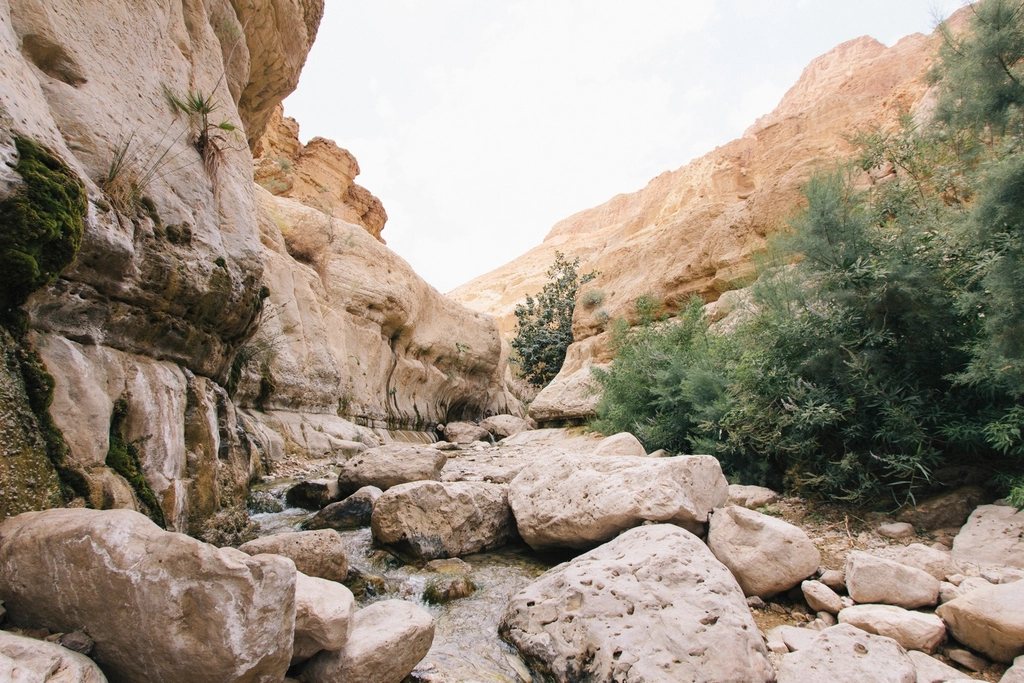
The Desfiladero de los Gaitanes is a narrow gorge cut by the Guadalhorce river through a block of limestone that rises to a few hundred metres above the water. The rock is grey and orange, generally compact and sharp in the lower sectors, with tufas and steep, pocketed caves higher on the mountain. The village sits at the southern end of the gorge, beside the reservoir that feeds the hydroelectric station below, and the main cliffs stand directly above it.
The limestone here varies more than at some destinations. On the slabs and the vertical walls the holds are crisp and the friction excellent, but there are also sectors of polished rock where decades of traffic have left a glassy sheen on the footholds. New sectors further along the mountain have opened in the past two decades with better bolting and fresher rock, and the climbing keeps spreading westward.
The main sectors: Frontales, Escalera Arabe and the Makinodromo
Las Frontales is the big wall that dominates the village, a wide face several hundred metres high, split into lower and upper tiers. The lower walls hold dozens of single-pitch sport routes from about 5 to 7a, ten to fifteen minutes on foot from the village. Above them, the upper Frontales gives multi-pitch routes of five to eight pitches at moderate grades, mostly bolted but with occasional sections where a small rack helps. A party moving well can be on top by early afternoon.
Escalera Arabe, the Arab staircase, is a hillside of tiered slabs and short walls to the east of the village, reached by a track of thirty to forty minutes that climbs past an old set of stone steps built long ago to reach the plateau above. The sectors here face south and west, catch the winter sun all day, and hold a large concentration of routes in the 4 to 6b range. It is the place where visiting groups take their first days, and it can be busy at weekends.
The Makinodromo is the other end of the spectrum. Reached by a walk of around forty-five minutes along the old railway line and up a steep path, it is a long, heavily overhanging wall of tufas and pockets with routes mostly from 7a to the low 8s, several of them forty metres or more. On a cold winter day with the sun on the wall it is one of the best steep sport crags in the country. Bring an eighty-metre rope, and check that the tufas are dry, because the wall seeps for a few days after heavy rain.
Beyond these three there are many more sectors: the Poema de Roca cave, the Cotos walls, and a string of crags scattered across the plateau reached by car or by a longer walk.
The walkway on the wall
Any visit to El Chorro runs into the Caminito del Rey, the walkway bolted to the gorge wall a hundred metres above the river. It was built in the first years of the twentieth century so that workers at the hydroelectric plants at each end of the gorge could move materials and inspect the channel. It became known as the King’s path after the monarch of the day walked its length for an inauguration in the early 1920s. Over the decades it decayed, the concrete crumbled, and by the end of the century sections had collapsed entirely. After a series of fatal falls it was closed officially around the turn of the millennium, though people continued to sneak along it.
A full reconstruction was carried out and the new walkway opened in 2015: a wooden boardwalk fixed above the old ruined path, with helmets provided and a one-way route through the gorge that takes a couple of hours. It requires a ticket booked in advance, and access to the gorge itself is now controlled. Climbers should know that some sectors inside the gorge fall under this management and may be subject to restrictions, so check locally before heading into the narrows.
Season, weather and the train from Malaga
The season runs from October to April, with November to February the core winter months. Daytime temperatures in the sun are often mild enough for a T-shirt even in January, while shaded sectors need a warm jacket at the belay. Rain does come, usually in spells of two or three days that pass through and leave the rock dry within a day on the open walls. Summer is too hot for most climbing, and even May can be uncomfortable on south-facing sectors.
What makes El Chorro unusual is that you can arrive without a car. The village has a station on the railway line that runs north from Malaga through the mountains, and regional trains take roughly forty minutes to an hour from the city’s main station. Several run each day, and the walk from the platform to the nearest accommodation is a few minutes. A car does open up the plateau sectors and the option of days on other Andalusian crags, but a full week of climbing is entirely possible on foot.
Staying, resting and looking after the place
Accommodation is a mix of small bunkhouses, a few guesthouses and apartments in the village and on the hill above it. Most cater directly to climbers and can be fully booked at the peak of the season around the new year. There is a small shop, a couple of bars and restaurants, and not much else, which is part of the appeal. For rest days the reservoirs offer walks and, in warmer months, swimming, and the ruins of a ninth-century hilltop settlement with a church cut into the rock lie a short drive away.
The gorge is a protected natural area and the village has learned to live with visitors. Park where you are asked, keep to the paths on the approaches, leave the fig trees and the goats alone, and do not climb on any sector where a sign or a local asks you not to. Winter sun is a gift; the courtesy that keeps the access open is cheap in comparison.