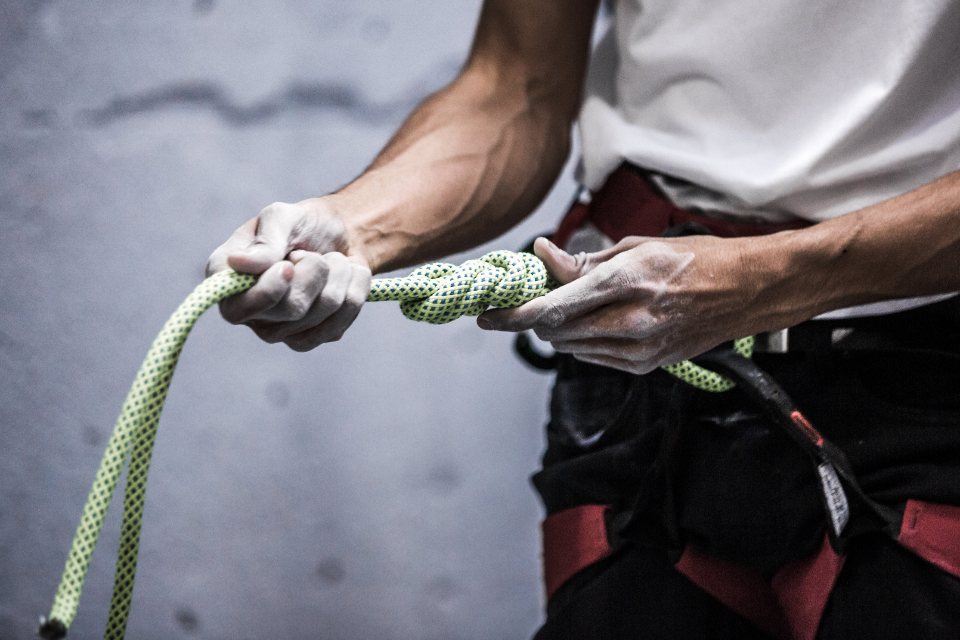
Almost everyone who climbs long enough will hurt a finger. The pulleys and flexor tendons of the hand are asked to hold body weight on holds the width of a pencil, and sooner or later one of them says no. Most of these injuries heal well if they are recognised early, respected and rehabilitated in the right order. Most of the long-term problems we see come from doing the opposite: pushing through, guessing, and going back to hard crimping too soon. This is a general guide from people who have been through it; it does not replace a hand specialist.
What the pulleys and tendons actually do
Two long flexor tendons run down each finger from the forearm. One bends the middle joint, the other the fingertip. Along the finger, a series of fibrous bands called annular pulleys hold those tendons close to the bone so that they act like a cable through a set of rings rather than a bowstring. The A2 pulley, at the base of the finger, and the A4 pulley, over the middle bone, are the workhorses. When you crimp, the tendons try to pull away from the bone, and the pulleys resist that force.
A full crimp, with the fingertip joint bent backwards and the middle joint sharply flexed, loads the A2 pulley roughly three times harder than an open-hand grip on the same hold. That is why the A2 of the ring or middle finger is the most commonly injured structure in climbing, and why the first rule of prevention is not a strength exercise but a grip choice.
The pop and the grades of injury
The classic pulley injury announces itself with a pop, sometimes audible, during a hard move on a small hold or when a foot cuts loose and the fingers take a sudden load. Pain follows at the base of the finger, with swelling over the next hours and tenderness on the palm side.
Clinicians grade pulley injuries by how many are torn and how completely. Grade I is a strain or partial tear with no loss of function beyond pain. Grade II is a complete rupture of A4 or a partial tear of A2 or A3. Grade III is a complete rupture of A2 or A3 on its own. A fourth grade, with several pulleys ruptured together, may need surgery and is not something to self-manage. The distinction matters because it sets the timeline, and it cannot be made reliably by feel. An ultrasound scan by someone who knows hands can measure the distance between tendon and bone and show bowstringing directly.
Flexor tendon and other finger problems
Not every sore finger is a pulley. The flexor tendons themselves can become inflamed, particularly where they pass through the pulleys, giving a diffuse ache along the palm side of the finger that is worse in the morning and better once warm. This tenosynovitis responds to rest and gradual loading rather than taping. Pockets, especially two-finger pockets, can injure the lumbrical muscles between the tendons in the palm, causing pain when one finger is loaded while its neighbour is left free. Joint pain at the middle knuckle that builds slowly over months is often a stress response of the joint capsule and bone rather than a tear, and it needs a different, longer approach.
First weeks: protect, then move
In the first few days after a pop, the finger should be rested from climbing, iced if it helps, and moved gently through its range so it does not stiffen. Complete immobilisation is not recommended for pulley injuries; the tissue heals better when it is asked to do a little. For grade I injuries, most rehabilitation protocols allow easy climbing on large holds after two to three weeks, with a return to full loading over four to six weeks. Grade II typically means four to six weeks before easy climbing and a progressive build of six to eight weeks. Grade III sits at six to eight weeks or more before climbing, with three months or longer of careful, taped, open-handed loading before hard crimping is attempted.
Loading in this phase means exactly that: hanging from a large edge or jug with feet on the ground, at a fraction of body weight, for short holds, progressing every few days if there is no pain during or the next morning. The next-morning test is the one that matters. A finger that feels fine while warm and aches at breakfast has been overloaded.
Taping and the no-crimp phase
The H-tape method has some research behind it. A strip of non-stretch tape is cut lengthwise from both ends to leave a bridge in the middle, the bridge is laid across the palm side of the middle joint, and the four tails are wrapped around the finger above and below the joint so the tape forms an H. Applied with the joint slightly flexed, it supports the tendon close to the bone near A3 and reduces bowstringing modestly.
The no-crimp phase is the rehabilitation rule that most people break. For the length of the progressive loading period, all climbing is done open-handed: fingers draped over the hold, middle joints barely bent, no thumb over the index finger. It feels weak and it is humbling on small holds, which is the point; those holds are off limits anyway.
Getting help, and preventing the next one
Any pop with swelling, any visible bowstringing when you flex the finger against resistance, any loss of the ability to make a full fist, or any pain that has not clearly improved after two weeks of rest is a reason to see a hand therapist or a doctor with sports hand experience. A single consultation and a scan can turn a guess into a plan. Numbness, a finger that will not straighten, or pain far up the forearm are urgent.
The single most effective prevention is a proper warm-up. Fifteen to twenty minutes of easy climbing on big holds, building steadily through the grades before the first hard move, raises tissue temperature and lets the tendons and pulleys adapt to load. Cold fingers on a hard crimp in the first ten minutes is the most common story behind the pop. After that, it is a matter of habits: preferring open hand and half crimp over full crimp when the hold allows, keeping feet on rather than campusing through moves, listening to the first dull ache instead of the fifth, and taking rest days seriously. Pulleys adapt to training more slowly than muscles do, so gains in finger strength should be built over months and years, not weeks. The fingers that last are the ones we treated as fragile.