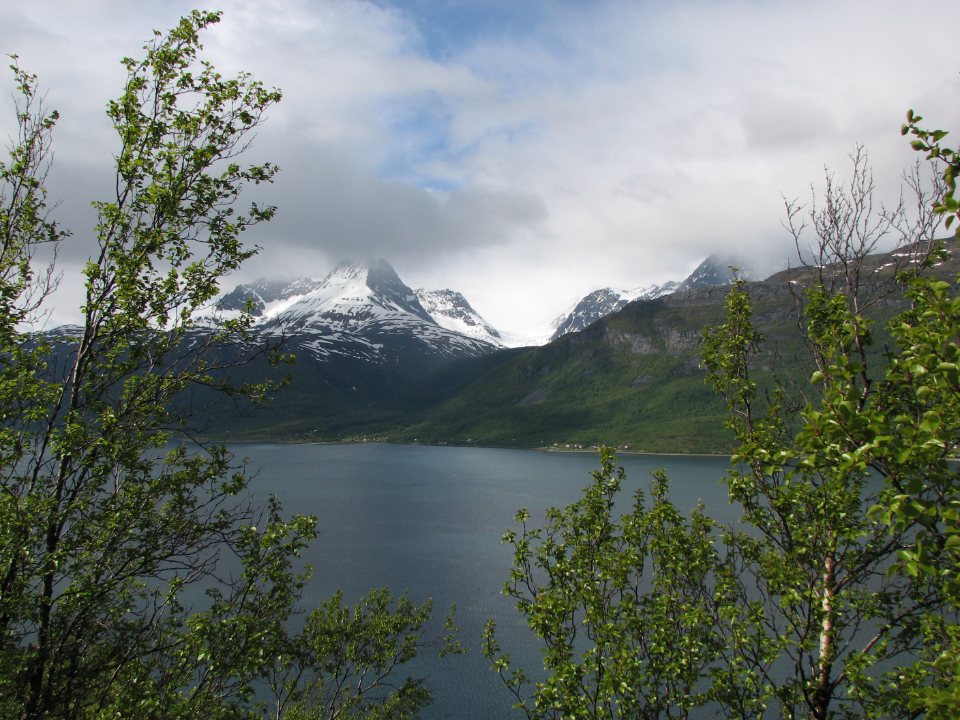
North of the Arctic Circle, on a peninsula about 90 kilometres long and rarely more than 20 wide, the Lyngen Alps rise straight out of the sea to summits between 1,000 and 1,800 metres. There is no valley floor to warm up on: the tour starts at the tide line and finishes on a ridge with the fjord on both sides. Skied from a base in Tromso, a road-end cabin or the deck of a sailboat, it is the most complete sea-to-summit skiing we know, and the light in the second half of the season is unlike anything in the Alps.
Where it is
The Lyngen peninsula lies roughly 70 kilometres east of Tromso, at about 69.5 degrees north, between the Ullsfjord on the west and the Lyngenfjord on the east. Tromso itself sits at 69.65 degrees north, more than 300 kilometres inside the Arctic Circle, and its airport has year-round connections to Oslo; from there it is about two hours by road and car ferry to the peninsula, either via the Breivikeidet to Svensby crossing on the west side or by driving around the head of the fjord. The peninsula has one main road along its western shore and a scattering of villages, of which Lyngseidet is the largest.
The highest point is Jiehkkevarri, at 1,834 metres (6,017 feet), a broad ice-capped massif that is a serious mountaineering objective rather than a casual ski tour. The touring classics are lower: peaks like Storgalten at 1,219 metres (3,999 feet), Kavringtinden at 1,289 metres (4,229 feet) and the summits above the Kjosen arm of the fjord, typically climbed in 1,000 to 1,400 metres of vertical from a car park at the shore. The sea is the zero line, which makes the numbers honest.
Snow from the Atlantic
Lyngen’s snow is maritime. Weather arrives from the Norwegian Sea and the North Atlantic on the west and south-west, and the warm current that runs up the coast keeps the fjords ice-free and the winters milder than the latitude suggests. The result is a deep, generally well-bonded snowpack, more like the Coast Range of British Columbia than the continental Rockies, with the same trade-offs: heavy snowfall, frequent wind, rain to surprising heights in a mild spell and a persistent-layer problem that is less common but not absent. A cold, clear snap in January can produce facets that stay reactive under the spring snow.
Wind is the daily fact of life. The summits are exposed to everything coming off the sea, and lee slopes below the ridges load quickly. Reading the wind history of the last few days is the first job on any Lyngen morning, and the second is watching the sky to the west, because a front from the Atlantic can turn a clear day into a whiteout in two hours. A good weather window in Lyngen is worth a long day.
The season and the light
The touring season runs from late February into May, and each month has a different character. In March the days are still short, the snow is cold and the summits often hold powder, but the polar night is a memory and the light is returning at a rate of about ten minutes a day. April is the classic month: long days, settled weather more often, deep snowpack, corn on the sun-facing slopes by afternoon and cold snow on the north faces. The hills are also busiest, and the roadside car parks fill early.
May brings the midnight sun, which in Tromso begins around 20 May and lasts until late July. Once the sun stops setting, the whole idea of a day dissolves. We have started a climb at eleven in the evening, skied corn at three in the morning while the fjord glowed pink, and been back at the boat for breakfast. The snow is spring snow by then, retreating up the hill, with a walk at the bottom that grows week by week, but the light makes up for it.
From the water
A sailboat is the way many groups approach Lyngen, and the logic is sound. The fjords are sheltered, the boat moves to whichever coast has the best conditions, and a tour can start from a beach that has no road behind it. A typical week involves anchoring in a bay, being dropped on the shore by dinghy, climbing 1,000 to 1,500 metres to a summit, skiing back to the water and being picked up, with the next anchorage reached during dinner. It is expensive relative to a cabin, and it depends on a skipper who knows the fjords and a guide who knows the snow, but it removes the ferry timetables and the car parks from the equation entirely.
The alternative is a base on the peninsula itself, at one of the small guesthouses or rented cabins, and a car. Tours then start from the road, and the classic summits are all reachable. Either way, the peninsula has no lifts, no groomed runs and no mountain huts in the Alpine sense; everything is self-supported, and the nearest rescue is a helicopter from Tromso.
What a Lyngen day looks like
A typical tour begins at sea level, often through birch woods for the first 300 metres, then onto open slopes where the wind has worked the snow and the aspect starts to matter. The ridges are broad and the summits are frequently corniced, sometimes heavily, over drops to the fjord. The descent is the reward: 1,000 metres or more of fall line with the sea in view the whole way down, and, in April, a change of snow from cold on top to corn at the shore.
- Full avalanche kit and the practice to use it, with no ski patrol anywhere on the peninsula.
- Ski crampons and boot crampons, because the wind leaves hard snow on many ridges.
- Serious sun protection from April on; snow, sea and long days multiply the exposure.
- Warm, windproof layers for summits that can be 20 degrees colder than the shore.
Lyngen is not a place for a first ski tour. It rewards people who already have the skills and want to use them somewhere the mountain meets the water. But for those people, a week in April, with a boat below and the sun refusing to go down, is about as good as touring gets.