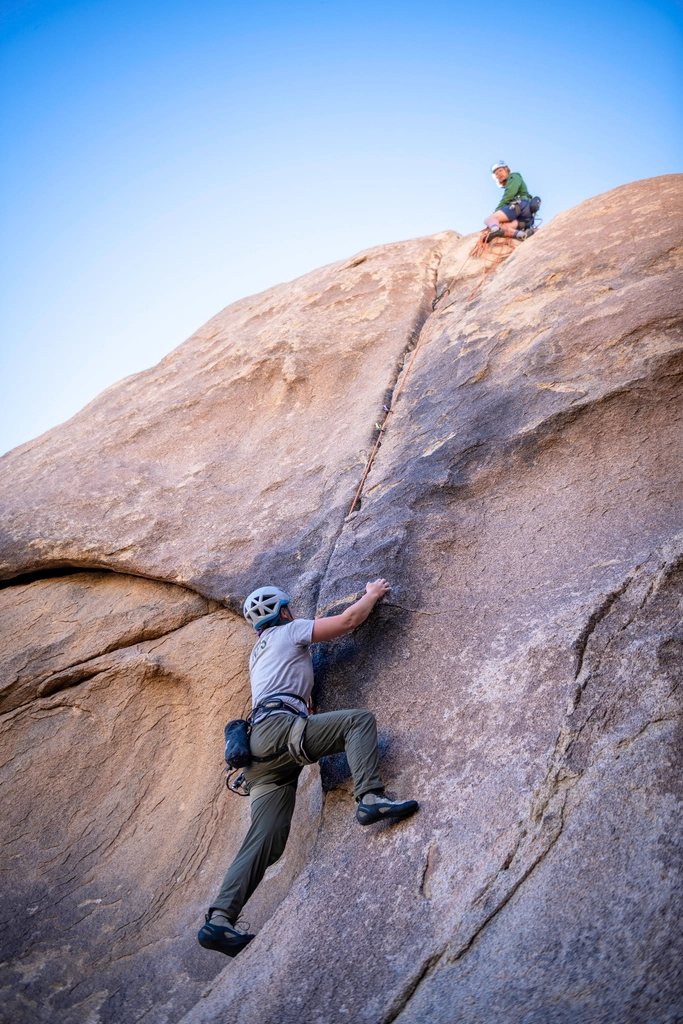
There is a line of low brown cliffs along the eastern edge of the Peak District in northern England that has shaped how a whole country climbs. None of them is more than about thirty metres high and most routes are far shorter. There are no bolts, and there never will be. Yet gritstone climbing, on edges like Stanage, Froggatt and Burbage, remains one of the most demanding forms of traditional climbing we know, and it teaches lessons that transfer to every big wall in the world.
What gritstone is
Gritstone is a coarse sandstone laid down in river deltas during the Carboniferous period, roughly 300 million years ago. The grains are large and angular, bound tightly enough that the rock is hard-wearing, which is why it was quarried for millstones and grinding stones for centuries. The Peak District edges are natural outcrops of this rock, weathered into rounded aretes, horizontal breaks, flared cracks and smooth slabs.
For a climber the texture is everything. Gritstone offers extraordinary friction: a well-placed foot on a blank slab stays put in a way that seems impossible until you trust it. But the rock is rounded rather than sharp, so positive holds are rare. Climbing here is about jamming hands and fists into cracks, smearing feet on nothing, pressing down on sloping ledges and committing to rock-overs onto rounded tops.
The edges: Stanage, Froggatt, Burbage and their neighbours
Stanage Edge is the longest and most famous, running for roughly six kilometres along a moorland escarpment above the Hope Valley. It holds well over a thousand routes across every grade, from easy scrambles used by generations of beginners to some of the hardest and boldest lines on grit. The popular end near the main car parks offers dozens of classic routes between 10 and 20 metres, on which the polished starts show a century of traffic. Approach times are five to twenty minutes from the road.
Froggatt Edge, a few miles south, is quieter and prettier, reached by a gentle walk through birch woods. It is known for immaculate slabs and a series of thin cracks, and for a handful of routes where the line between a bold lead and a highball boulder problem becomes philosophical. Burbage, closest to Sheffield, has a north end of short, friendly routes on good rock and a south end of quarried walls where the climbing is steeper and the landings less forgiving. Nearby Curbar, Millstone and the Roaches each add their own character, from strenuous cracks to sharp quarried aretes and finger cracks.
The no-bolt ethic
Bolting is not permitted on natural gritstone anywhere in the Peak District, and pegs are no longer placed either. The ethic dates back to the earliest days of climbing here, in the late nineteenth century, and it has held through every fashion since. Routes are protected by what the leader can place on the way up: nuts and cams in the breaks and cracks, slings over flakes, and occasionally nothing at all. A climb is graded for its difficulty and for its seriousness, using the British adjectival system in which a route can be technically easy but psychologically committing.
The result is that gritstone routes are short but rarely trivial. A twelve-metre climb with the crux six metres above the last good placement asks a very different question from a bolted wall three times its height. The ethic also keeps the crags in a natural state: apart from chalk and some polish, an edge looks much as it did a hundred years ago. Local feeling on the subject is strong and long-lived.
Cold, dry and windy is good
Gritstone friction depends on conditions in a way that surprises people used to limestone. In warm or humid weather the rock feels greasy and smears slide. In cold, dry air with a breeze, the same holds feel like sandpaper. The classic grit season runs from autumn to early spring, and the best days are often the crisp, bright ones in November and February when the moor is frozen and the sun is low.
The rock must be dry. Wet gritstone is soft and the surface grains can be rubbed off, leaving permanent damage on holds that took a millennium to form. After rain the edges dry quickly in wind, but the breaks and the shaded faces hold water longer. Never brush a wet route, never use a wire brush on grit at any time, and keep chalk to what is needed.
Summer climbing is possible but often uncomfortable and crowded, and the moorland can be busy with walkers and grouse-shooting activity in late summer.
Access, birds and the rules of the moor
Most of the edges are within the Peak District National Park, and large sections are owned by the park authority or by the National Trust, with open access for walkers and climbers. That access was won slowly: the mass trespass on Kinder Scout in 1932 is part of the history of the right to roam in this country, and the edges are open today because of it.
Access comes with conditions. The most important for climbers is the seasonal bird restriction. Ring ouzels and other ground-nesting birds breed on parts of Stanage and other edges from roughly February to July, and specific sections of crag are closed during those months, with signs at the base and notices published by the national climbing body. Check before you go and respect the closures; they change year to year. Other rules of the moor are common sense:
- Keep dogs on a lead near sheep and during the nesting season.
- Do not light fires, camp or leave litter on the edges.
- Use the designated car parks and pay the fees that maintain them.
- Stay on paths on the approach to avoid eroding the peat and heather.
Sheffield as a base
Sheffield is the natural base. The city lies less than half an hour from Burbage and Stanage by road, and public buses reach several of the edges from the centre on most days. It has more climbing walls, gear shops and climbers per head than any other city in the country. Hathersage, the village below Stanage, has accommodation, cafes and shops if you prefer to stay in the valley.
Come with a rack of nuts, a set of cams from finger to fist size, plenty of slings for the breaks and flakes, a rope of fifty metres (more is unnecessary), and a willingness to fail on routes that look easy. Gritstone gives up its secrets slowly, and that is the point.