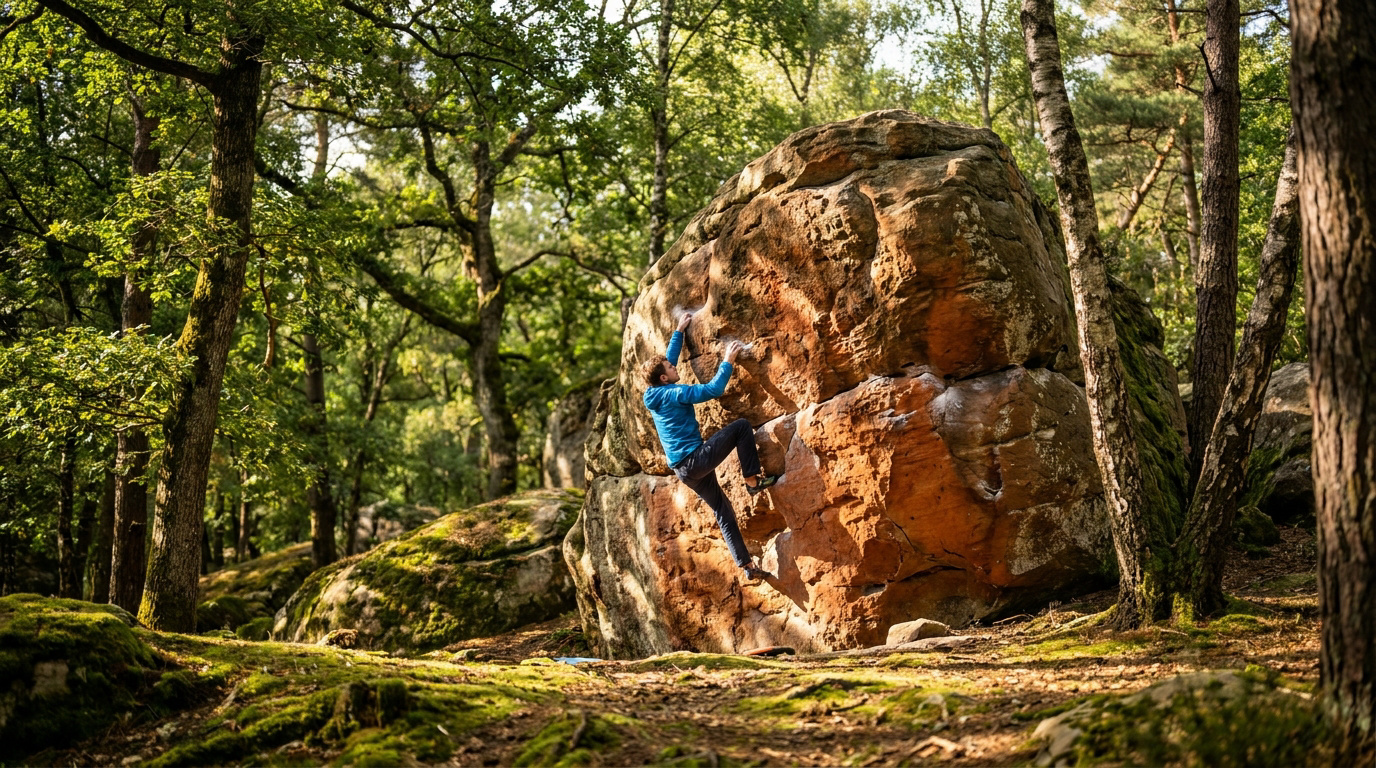
Key takeaway: Fontainebleau’s unique color-coded circuits, ranging from yellow for beginners to white for experts, offer a structured way to build endurance and technical mastery. By following these numbered sandstone problems, climbers develop vital friction-based skills like smearing and mantling. Always prioritize rock preservation by climbing only on dry sandstone to protect this historic bouldering heritage.
The sandstone boulders of Fontainebleau have served as a rigorous training ground for alpinists since the earliest structured circuits were painted to guide climbers through the forest. You might arrive confident in your indoor strength, only to find yourself sliding off a technical 5c slab that feels impossible to read.
Understanding the logic of color-coded circuits and the nuances of the French grading system is the only way to master this cerebral terrain. We will break down how to interpret the rock and align your skills with the unique demands of the forest.
- Bouldering Fontainebleau Guide to Color-Coded Circuits
- 3 Technical Keys to Reading Sandstone
- Logistics for a Successful Forest Trip
- Ethics and Gear for Sandstone Preservation
Bouldering Fontainebleau Guide to Color-Coded Circuits
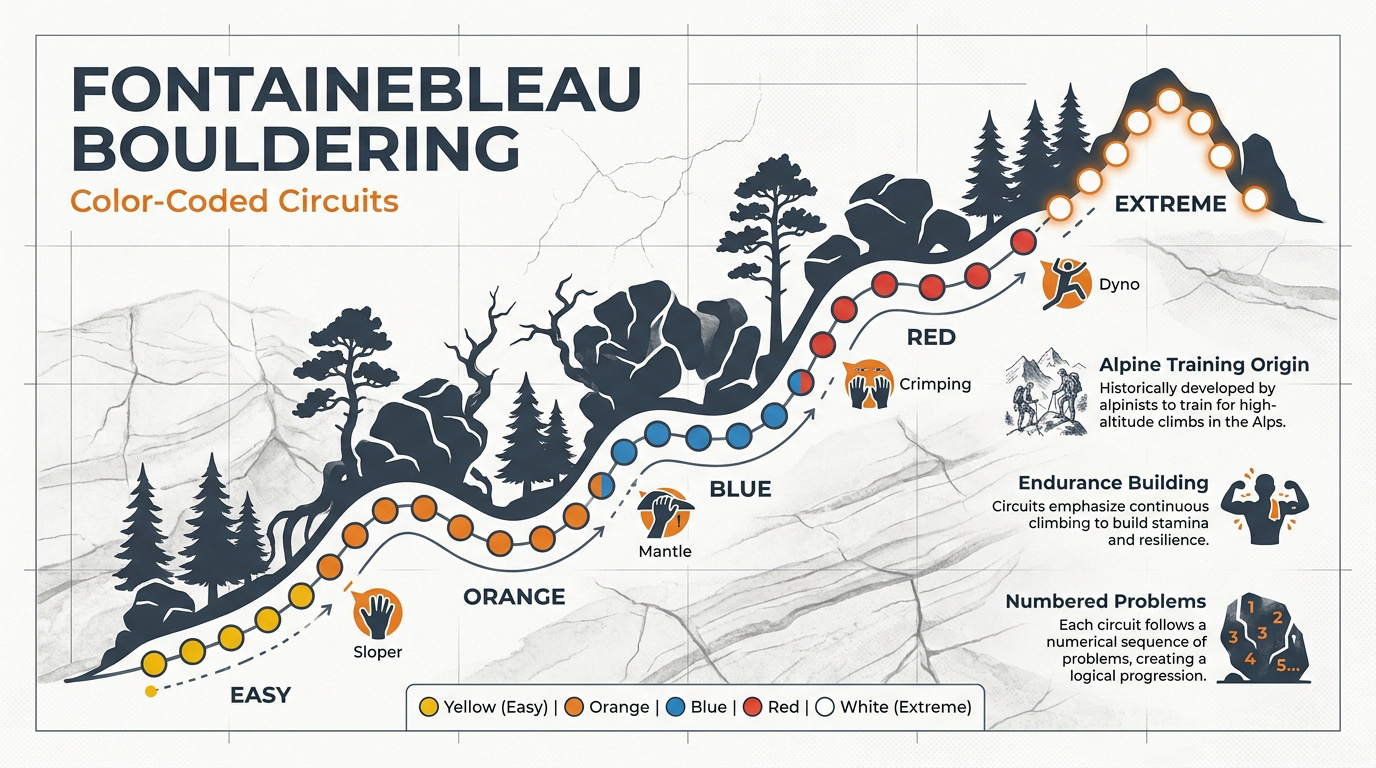
Fontainebleau uses a unique color-coded circuit system ranging from yellow (easy) to white (extreme). These circuits, originally designed for Alpine training, build endurance through numbered sandstone problems requiring specific techniques like slopers and mantles.
Here is a transition sentence to bridge our historical overview with the specific logic behind these painted paths.
Understanding the Logic of Painted Circuits
The circuit tradition dates back to the late 19th century. The first structured circuits at Cuvier Rempart were painted in the twentieth century to guide climbers through the sandstone chaos. These markings were meant to mimic long Alpine ridges for mountain training. They represent a unique heritage.
Colors follow a strict progression. Beginners start with yellow or orange markings. Experts tackle blue, red, or white circuits. Each step up demands significantly more physical power and precision.
Following numbered problems builds massive stamina. Completing a full loop creates a psychological flow. It forces consistent movement across the forest floor. The endurance benefits are unmatched for serious climbers.
Circuit colors directly translate to specific difficulty levels. This leads us to the grading comparison.
How Font Grades Compare to the V-Scale
Converting grades requires a specific table. A Font 6A typically aligns with V2 or V3. Meanwhile, 7A equals V6. The French grading system uses letters to refine these nuances.
Indoor climbers often face a brutal reality check. Sandstone feels much harder than plastic holds. Precise footwork is mandatory here. Friction fluctuates with humidity, making technical 5c slabs feel impossible for the uninitiated.
Grading remains highly subjective. Reach and specific morpho-features change everything on sandstone. It is a cerebral game.
The difficulty gap is real. Leave your ego at the parking lot before touching the rock. Focus on the movement instead.
3 Technical Keys to Reading Sandstone
Understanding the grades is just the start; mastering the specific rock textures of the forest is what actually gets you to the top.
Mastering Slopers and Identifying Grattons
Friction here is pure mechanics. Use open-hand grips on these rounded holds to stay attached. Keep your center of gravity low. Maximize skin-to-rock contact for better grip.
Look for tiny shadows on blank faces to spot “grattons”. Use side-lighting to identify these subtle textures. These small crystals are vital for high-level vertical problems. Precision is absolutely mandatory here.
Adjust your body tension constantly. Engage your core, especially on low-friction days. Move slowly to avoid slipping. Focus on controlled breathing during the crux.
Shift focus to feet. Slabs require even more subtle balance.
Slab Movement and the Art of the Mantle
Foot placement is everything on a slab. Use the “smearing” technique on vertical faces. Trust your rubber. Keep your heels low to increase friction.
Master the mantle shift next. Press down hard with your palms. Bring your foot up near your hand. This “beach press” move requires shoulder stability and total commitment.
Build trust in your contact points. Sandstone is surprisingly sticky when dry. Do not hesitate mid-move. Believe in the friction coefficient of your climbing shoes.
Prepare for the exit. Mantling is often the hardest part.
Logistics for a Successful Forest Trip
Technical skill won’t help if you end up at a damp sector, so planning your arrival and location is the next vital step.
Picking the Right Season and Fast-Drying Sectors
Analyze humidity and temperature carefully. Cold, dry air provides the best “collante” for those tiny holds. Avoid humid summer mornings. Friction is weather-dependent in Fontainebleau.
List fast-drying sectors for your itinerary. Bas-Cuvier and Roche aux Sabots are excellent choices. They sit on sandy plateaus. Wind helps dry the rock quickly after rain. Seek exposed areas during the shoulder seasons.
Compare trip styles before booking. Winter is for performance and hard projects. Summer is better for social circuits and picnics. Choose your climbing window wisely.
Transition to navigation. Finding these sectors requires the right tools.
Finding Your Way via Guidebooks and Apps
Compare guides before entering the woods. Traditional paper guidebooks offer historical context. Digital apps provide GPS coordinates. Both are useful for complex forest navigation.
Discuss transport options with your group. A car is best for remote sectors. However, trains from Paris reach Fontainebleau-Avon. Some sectors like Mont Ussy are walkable from town. Biking is a valid alternative.
Suggest accommodation to fit your budget. Look for gites in Milly-la-Forêt. Local campsites are popular in spring. Staying in Barbizon offers a historic atmosphere.
Final logistics tip. Always carry a physical map as backup.
Ethics and Gear for Sandstone Preservation
Once you arrive at the boulders, respecting the fragile sandstone environment ensures the forest remains open for everyone.
The Pof Controversy and Wet Rock Rules
Damp sandstone becomes extremely fragile and porous. Holds can snap off easily. Never climb if the rock feels sandy or cold. Respecting these conditions protects the forest for future generations.
Pof is traditional pine resin. It creates a sticky layer but can glass the rock. Modern chalk is preferred but must be brushed off. Use minimal amounts to preserve friction. Avoid “plastering” the stone with white marks.
Bring a soft boar-hair brush. Use a doormat to clean your shoes. Keeping sand off the holds prevents erosion. These simple tools stop your climbing shoes from acting like sandpaper on the boulders.
Climb smart. Preservation includes taking care of your own body while protecting the ancient crags.
Managing Skin Health and Preventing Font Elbow
Sandstone is incredibly abrasive. Use wax-based creams after climbing. Maintaining skin elasticity prevents painful splits or “flappers”. Regular hydration keeps your fingertips ready for the next day of technical crimping.
Detail antagonist exercises. “Font elbow” is common from heavy mantling. Perform reverse wrist curls. Push-ups help balance the pulling muscles. Prevent tendonitis by warming up thoroughly every time. Don’t skip the basics.
Take rest days between intense sessions. Visit the local chateau or forest trails. Active recovery keeps your blood flowing. It is better to rest than to risk a season-ending injury.
Stay sharp. Listen to your body to avoid long-term injuries during your Fontainebleau bouldering trip.
Mastering Fontainebleau’s color-coded circuits and technical sandstone requires precise footwork and respect for the rock’s friction. Apply these keys by choosing fast-drying sectors like Bas-Cuvier to practice your mantles today. Elevate your climbing performance now to conquer the forest’s legendary sandstone challenges before the next rain.
FAQ
What exactly are the color-coded circuits in Fontainebleau?
The circuits in Fontainebleau are a unique heritage of the forest, consisting of a series of numbered bouldering problems marked with specific paint colors and arrows. Originally designed to train alpinists for long mountain ridges, these circuits allow climbers to follow a logical path through the sandstone chaos, testing both technical skill and physical endurance.
Each color represents a difficulty range: yellow (PD) and orange (AD) are perfect for beginners, while blue (D) and red (TD) cater to intermediates. The most demanding challenges are found in the black (ED) and white (ED+) circuits, which are reserved for expert climbers looking to push their limits on world-class sandstone.
How do Fontainebleau grades translate to the V-Scale?
Translating “Font grades” to the American V-Scale is not an exact science, but there are general benchmarks to help you navigate. A 6A problem typically aligns with V2 or V3, while a 7A is roughly equivalent to a V6. The French system uses numbers and letters (e.g., 6C+) to provide a more granular evaluation of the entire problem’s difficulty.
It is important to remember that Fontainebleau sandstone often feels harder than indoor climbing. The technical nature of the rock means that a 5c slab might feel more difficult than a V4 in a gym. When visiting for the first time, it is wise to leave your ego at the parking lot and start with lower grades to adapt to the specific friction and movement of the forest.
What are the best techniques for climbing on Font sandstone?
Success in the forest relies heavily on mastering slopers and the art of the mantle. Because the sandstone is exceptionally smooth, you must maximize skin-to-rock contact by using open-hand grips and keeping your center of gravity low. Precision is key; look for “grattons” or micro-edges that appear as tiny shadows on the rock face to find your way up vertical problems.
Footwork is equally critical, especially the “smearing” technique where you trust the friction of your rubber on blank slabs. The classic “beach press” mantle, pressing down with your palms to haul your body over the top, is a staple move here. Maintaining shoulder stability and core tension will help you navigate these technical sequences without slipping.
When is the best time to visit the forest for bouldering?
The ideal conditions for bouldering in Fontainebleau occur when the air is cold and dry, providing the best “collante” or friction. Spring and autumn are generally the most popular seasons. However, winter offers the highest performance potential for hard projects, provided the rock is dry. Summer is better suited for social circuits and climbing in shaded sectors during the early morning.
If it rains, focus on fast-drying sectors like Bas-Cuvier or Roche aux Sabots, which are located on sandy plateaus and benefit from wind exposure. Always check the humidity levels, as high moisture significantly reduces the friction coefficient of the sandstone.
Why is it forbidden to climb on wet sandstone?
Sandstone is a porous rock that becomes extremely fragile when damp. Climbing on wet rock can cause holds to snap off easily, leading to irreversible damage to historic problems. If the rock feels sandy or cold to the touch after rain, it is essential to wait until it is completely dry before starting your session.
To further preserve the forest, climbers should use minimal chalk and always brush off their holds with a soft boar-hair brush. Using a doormat to clean sand off your climbing shoes is also mandatory to prevent the abrasive erosion of the rock surface. Respecting these rules ensures the forest remains a world-class destination for future generations.
How can I avoid injuries like “Font elbow” while climbing?
The intense mantling and pulling required in Fontainebleau can lead to tendonitis, often called “Font elbow.” To prevent this, incorporate antagonist exercises like reverse wrist curls and push-ups into your routine. A thorough warm-up before every session is vital to prepare your tendons for the unique stresses of sandstone climbing.
Additionally, the rock is incredibly abrasive, so managing your skin health is a priority. Use wax-based skin balms after climbing to maintain elasticity and prevent painful splits or flappers. Remember to schedule rest days to allow for active recovery, perhaps by exploring the local trails or the historic town of Barbizon.
FAQ
What exactly are the color-coded circuits in Fontainebleau?
The circuits in Fontainebleau are a unique heritage of the forest, consisting of a series of numbered bouldering problems marked with specific paint colors and arrows. Originally designed by Fred Bernick in 1947 to train alpinists for long mountain ridges, these circuits allow climbers to follow a logical path through the sandstone chaos, testing both technical skill and physical endurance.
Each color represents a difficulty range: yellow (PD) and orange (AD) are perfect for beginners, while blue (D) and red (TD) cater to intermediates. The most demanding challenges are found in the black (ED) and white (ED+) circuits, which are reserved for expert climbers looking to push their limits on world-class sandstone.
How do Fontainebleau grades translate to the V-Scale?
Translating “Font grades” to the American V-Scale is not an exact science, but there are general benchmarks to help you navigate. A 6A problem typically aligns with V2 or V3, while a 7A is roughly equivalent to a V6. The French system uses numbers and letters (e.g., 6C+) to provide a more granular evaluation of the entire problem’s difficulty.
It is important to remember that Fontainebleau sandstone often feels harder than indoor climbing. The technical nature of the rock means that a 5c slab might feel more difficult than a V4 in a gym. When visiting for the first time, it is wise to leave your ego at the parking lot and start with lower grades to adapt to the specific friction and movement of the forest.
What are the best techniques for climbing on Font sandstone?
Success in the forest relies heavily on mastering slopers and the art of the mantle. Because the sandstone is exceptionally smooth, you must maximize skin-to-rock contact by using open-hand grips and keeping your center of gravity low. Precision is key; look for “grattons” or micro-edges that appear as tiny shadows on the rock face to find your way up vertical problems.
Footwork is equally critical, especially the “smearing” technique where you trust the friction of your rubber on blank slabs. The classic “beach press” mantle, pressing down with your palms to haul your body over the top, is a staple move here. Maintaining shoulder stability and core tension will help you navigate these technical sequences without slipping.
When is the best time to visit the forest for bouldering?
The ideal conditions for bouldering in Fontainebleau occur when the air is cold and dry, providing the best “collante” or friction. Spring and autumn are generally the most popular seasons. However, winter offers the highest performance potential for hard projects, provided the rock is dry. Summer is better suited for social circuits and climbing in shaded sectors during the early morning.
If it rains, focus on fast-drying sectors like Bas-Cuvier or Roche aux Sabots, which are located on sandy plateaus and benefit from wind exposure. Always check the humidity levels, as high moisture significantly reduces the friction coefficient of the sandstone.
Why is it forbidden to climb on wet sandstone?
Sandstone is a porous rock that becomes extremely fragile when damp. Climbing on wet rock can cause holds to snap off easily, leading to irreversible damage to historic problems. If the rock feels sandy or cold to the touch after rain, it is essential to wait until it is completely dry before starting your session.
To further preserve the forest, climbers should use minimal chalk and always brush off their holds with a soft boar-hair brush. Using a doormat to clean sand off your climbing shoes is also mandatory to prevent the abrasive erosion of the rock surface. Respecting these rules ensures the forest remains a world-class destination for future generations.
How can I avoid injuries like “Font elbow” while climbing?
The intense mantling and pulling required in Fontainebleau can lead to tendonitis, often called “Font elbow.” To prevent this, incorporate antagonist exercises like reverse wrist curls and push-ups into your routine. A thorough warm-up before every session is vital to prepare your tendons for the unique stresses of sandstone climbing.
Additionally, the rock is incredibly abrasive, so managing your skin health is a priority. Use wax-based skin balms after climbing to maintain elasticity and prevent painful splits or flappers. Remember to schedule rest days to allow for active recovery, perhaps by exploring the local trails or the historic town of Barbizon.