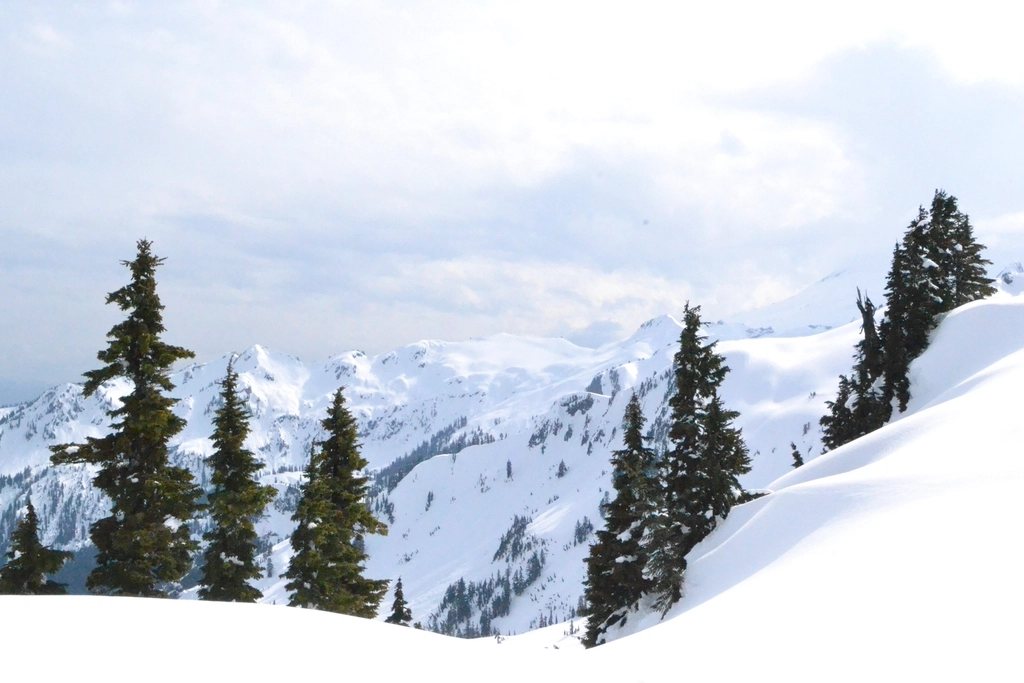
An avalanche burial is a race against a clock that the victim cannot see. Everything we practise with a transceiver, a probe and a shovel is aimed at one number: the time between the snow stopping and the airway being cleared. Organised rescue, however good, almost never arrives inside that window. Companion rescue, done by the people who were on the slope, is what saves lives, and it only works if it has been rehearsed until it is boring.
The survival curve
The best data we have on burial survival comes from Swiss accident records covering several decades. The curve they produce has a sharp shape. In the first fifteen minutes, survival is above 90 percent; the people who die in that phase are mostly killed by trauma on the way down. Between fifteen and about thirty-five minutes the curve drops steeply, to around 30 percent, as victims without an air pocket asphyxiate. After that the decline is slower, and the few who survive long burials almost always had an air space in front of the face and a route for exhaled carbon dioxide to escape.
The lesson is blunt. A full burial rescued in ten minutes will usually live. The same burial rescued in thirty will usually not. Every fumbled strap, every beacon switched to search a minute late, every argument about who does what comes straight off the top of that curve.
First seconds: watch, shout, switch
When a slope releases, the most valuable thing the rest of the group can do is watch the victim and fix the last point where they were seen. That point defines the top of the search area, because a buried person is almost never above where they disappeared. Once the snow has stopped, someone takes charge, counts who is missing and makes sure the slope above is not about to release again. Everyone switches their transceiver to search, and checks that everyone else has done so; a beacon left transmitting will pull the search onto a standing rescuer.
If there is mobile coverage, one person makes a short call for help, then rejoins the search. The call matters for the outcome after the digging, but it does not replace the digging. In a large group, one or two people can be assigned to look for surface clues, a glove, a ski tip, a pole, while the others search with beacons.
Signal, coarse and fine search
Modern avalanche transceivers transmit and receive on 457 kilohertz and reliably pick up a signal from roughly 40 to 60 metres away. The signal search covers the debris in strips no wider than that, starting at the last-seen point and moving down the fall line. The searcher moves fast, holding the beacon in front and glancing at it while also looking at the surface.
When a signal arrives, the coarse search begins. The beacon shows a distance and a direction arrow; we follow the arrow along the curved flux line rather than trying to walk straight, slowing down as the numbers drop, and start to crouch below about 10 metres. Inside roughly 3 metres we switch to the fine search, a bracketing pattern: beacon held flat and close to the snow surface, no rotation, moving along one axis until the distance reading stops falling and starts to rise, back to the lowest point, then the same on the perpendicular axis. The point of lowest reading is where the probe goes in. Done well, this takes about a minute; done badly, waving the beacon around, it can take five.
Probing with a pattern
Probing confirms the location and gives us the burial depth, which decides how we dig. The probe goes in perpendicular to the snow surface, not vertically, because the beacon signal reaches the surface along the same line. We start at the lowest-reading point and work outward in a spiral, with strikes about 25 centimetres apart, keeping each strike parallel to the first. A person feels distinctly different from rock or ice: softer, with a slight give. When we get a strike, the probe stays in the snow as a marker, and we read the depth off it before the shovel comes out.
Digging strategically
Shovelling is where most of the fifteen minutes goes, and the difference between digging well and digging badly is enormous. A burial at 1.5 metres involves moving something like a tonne of snow. Digging straight down onto the probe makes a narrow hole that gets deeper, harder and less useful the closer we get.
The technique that works is the V-shaped conveyor. On a slope, the lead digger starts downhill of the probe at a distance of about one to one and a half times the burial depth, and digs horizontally into the slope towards the probe rather than downward. Other diggers form a V behind the leader, moving snow back and sideways so it never has to be lifted twice. The leader rotates back every minute or two, because the front position is exhausting. The goal is a wide, sloping trench that reaches the victim’s head from the side, so the airway can be cleared quickly and the rest of the body freed without collapsing snow back onto the face.
Once the head is reached, the priority is the airway, then a look for an air pocket, then getting the victim horizontal and out of the wind. We handle them gently, because a cold body reacts badly to rough movement, and we keep the insulation going until help arrives.
Practising monthly, and managing the group
Every skill above decays within weeks. We run a beacon drill on the first tour of every month: a single burial, timed, from search mode to a probe strike, then a full dig once or twice a season. A realistic target is under eight minutes for a single burial by one rescuer. Multiple burials, close burials and deep burials are worth practising with a course or a club at least once a winter, because beacon marking functions behave differently under pressure.
The rest is group management, which is the part of rescue that happens before anything goes wrong. We cross suspect slopes one at a time, with the others watching from a safe spot, and we regroup only in places outside the runout of the slope above. We check every beacon at the trailhead, transmit and receive, every single day, and we agree before the tour who leads a rescue if the leader is the one buried. Rescue is what we hope never to need. Terrain choice is what keeps it that way. But on the day the slope goes, the only thing standing between a friend and the wrong side of that curve is how many times we did this in a car park in the dark.