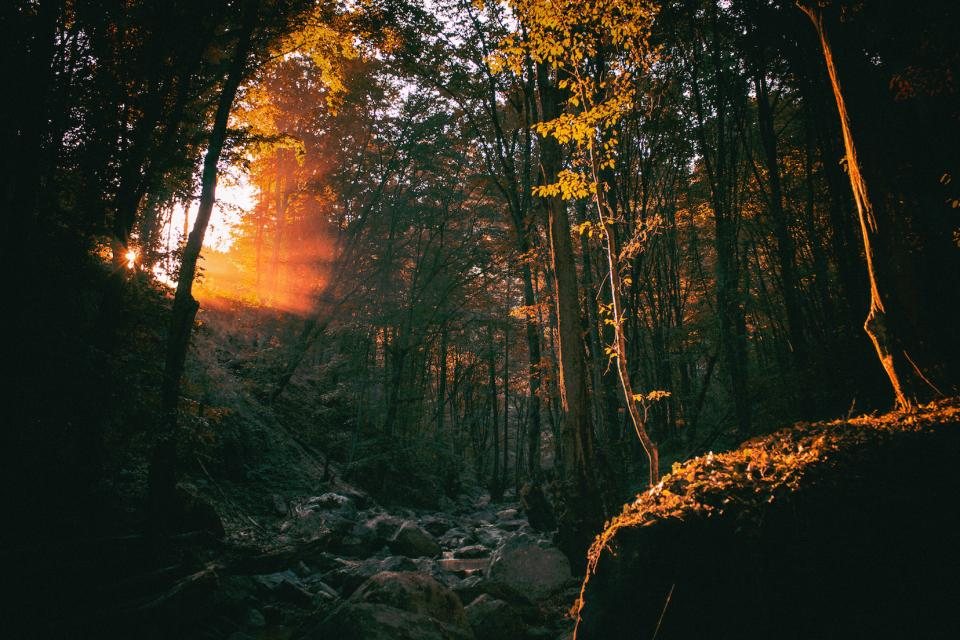
Some sixty kilometres south of Paris, a forest of pine, oak and beech hides tens of thousands of sandstone boulders scattered through the sand like sleeping animals. Fontainebleau is where bouldering was first treated as a discipline in its own right, and a century of climbers has left the place with a culture, a grading scale and a set of habits that still shape how we all boulder today. We have spent many weekends there, and we keep going back because the rock asks questions that no gym can quite reproduce.
A forest made of sand
The boulders of Fontainebleau are Oligocene sandstone, roughly thirty million years old, laid down as marine and dune sand and later cemented by silica into a hard crust over a much softer core. The forest itself covers around twenty-five thousand hectares and is public land managed by the national forestry office. The boulders sit in loose sandy hollows, on platforms of harder rock or on the crests of low ridges, which is why the areas carry names like Cuvier, Franchard or Apremont rather than the names of single cliffs.
What makes the rock special is its surface. The crust is fine-grained and slightly glassy in places, and it has been sculpted by water into rounded bulges, dishes and smooth ramps rather than into edges. The result is a style built on slopers, compression and precise footwork. Newcomers who arrive with strong fingers and no patience usually spend their first day sliding off problems graded far below their indoor level. That is normal. It happens to everyone.
Circuits: the colour-coded backbone
The great local invention is the circuit. Since the late 1940s, volunteers have painted small numbered arrows on the boulders to link problems into a route through an area, usually between twenty and sixty problems long. Each circuit is graded as a whole and identified by its colour. The traditional ladder runs from yellow (very easy, roughly Font 1 to 3) through orange (easy), blue (moderate, around 3 to 4+), red (hard, around 5 to 6b) and black (very hard, 6b and up). White circuits exist at both ends of the scale: in some areas they are for children, in others they are the hardest line in the sector.
Following a circuit is the best way to learn the forest. It moves you across the area, teaches you the rock in a logical progression and stops you from throwing yourself at one project all afternoon. A full blue circuit in a big area like Franchard Isatis is a serious day out, and finishing one in a single session is a legitimate goal that many strong indoor climbers fail on their first attempt. The circuits are maintained by volunteer associations, and the paint fades; a faint arrow is not an invitation to repaint it yourself.
Font grades and what they mean
The Fontainebleau grading scale runs from 1 to 9A and uses numbers, capital letters A to C and a plus sign, so 6B+, 7A and 7C are all Font grades. It was developed for circuit problems and it measures the difficulty of the moves, not the height or the danger of the landing. Conversions to the American V-scale are approximate: 6A sits near V3, 7A near V6, 7C near V9. In practice, forest grades feel stiff to visitors because the style is unfamiliar. A 6A sloper problem can shut down someone who cruises 6C on crimps in a gym. The grade is honest; the climber’s experience is not yet.
Dry rock, cool air and clean holds
Fontainebleau sandstone must be dry. When the crust is wet, the sand grains lose their bond and holds break under body weight, taking a slice of the boulder with them. After rain, we wait at least a day in summer and often two or three in the cooler months, and we test the surface of any hold before committing. If the rock feels cool and slightly damp to the palm, it is not ready. A boulder that looks dry in the sun may still be soaked on its shaded side.
Friction is the second variable. The sandstone grips best between about 0 and 10 degrees Celsius with low humidity, which is why the classic seasons are autumn, winter and early spring. Summer afternoons above 25 degrees turn slopers into soap. Locals go early, climb in the shade or take the season off. We also keep our chalk light. Excess chalk fills the tiny pores that give the rock its grip, and a brushed hold works better than a white one. Resin, sometimes called pof, has a long local history but leaves a glaze that degrades friction for everyone after you, so we leave it at home.
Bas Cuvier, Franchard and Elephant
Bas Cuvier is the historic heart of the forest, a compact area beside the main road between Fontainebleau and Barbizon where many of the first hard problems were done. It is crowded on weekends, the landings are flat and sandy, and the classic red and black circuits are a rite of passage. Expect polished holds on the most famous lines and plenty of company.
Franchard is a broad valley to the west with several areas, of which Isatis and Cuisiniere are the best known. The boulders are bigger, the walking longer and the circuits more varied, with genuine slab, steep prows and long traverses. It is a good choice for a mixed group.
Elephant sits outside the main forest, south near the village of Larchant, on a sandy plateau of tall, rounded boulders. The rock is a little coarser, the landings are soft and the atmosphere is quieter. It is the area we recommend to anyone who wants a first day of beginner-friendly circuits with a view.
Respecting the forest and getting there
The forest is a shared public space, not a climbing park. Fires are banned, wild camping is forbidden and parking is restricted to marked car parks; leaving a vehicle on a forest track can bring a fine. Sand should be brushed off holds but never off the boulder base into the vegetation. Pads dragged across roots and moss do lasting damage, so we carry them between problems and stack them on existing sand. Dogs on leads, rubbish carried out, and no music.
The forest is unusual among great bouldering areas in being reachable by public transport. Regional trains from the main station in central Paris reach Fontainebleau-Avon in about forty minutes, and Bois-le-Roi, a stop earlier, for the northern areas. From either station a local bus or a bicycle gets you to the trailheads. Many of us have done day trips from Paris with a pad on our backs. It is a strange and pleasant thing to leave a city at breakfast and be standing in sand under a beech tree, chalking up, before ten.