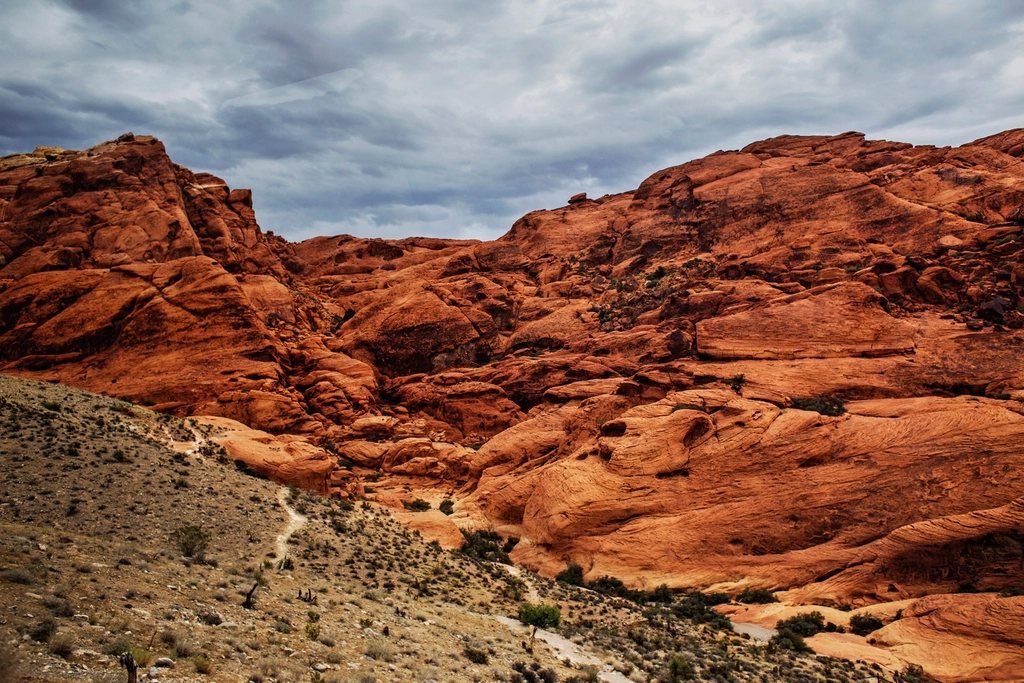
Twenty minutes west of the casinos, the desert folds up into a wall of red and cream sandstone that runs for miles along the base of the Spring Mountains. Red Rock Canyon National Conservation Area is one of the most accessible big-wall playgrounds in North America, with routes from a single pitch to more than a dozen, and a winter season that runs while most of the continent is frozen. It also has rules, some written and some simply understood, that every visiting party needs to know before they leave the parking lot.
Aztec sandstone and why it behaves the way it does
The cliffs at Red Rock are Aztec sandstone, fossilised sand dunes laid down in the Jurassic period roughly 180 million years ago. The bands of colour, from deep red at the base to pale cream and orange higher up, come from iron oxide staining that varies through the layers. Above the sandstone sits older grey limestone, pushed on top of the younger rock by a geological fault known as the Keystone Thrust.
For climbers the sandstone offers edges, huecos, varnished plates and rounded cracks. The darker, desert-varnished faces are generally the most solid and give the best friction. The lighter, softer bands can be crumbly, and holds on them deserve a tap and a look before you commit. Compared with granite, Red Rock rewards careful footwork over brute strength, and many long routes go at moderate grades precisely because the rock is so featured.
The 24-hour rain rule
Sandstone absorbs water. When it is wet, the grains lose much of the bond that holds them together, and holds that felt solid the day before can snap under body weight. The local convention, respected by nearly everyone and posted at trailheads, is simple: do not climb on Red Rock sandstone for at least 24 hours after significant rain, and longer after a heavy storm. Many experienced locals wait 48 hours after a soaking, and even longer for shaded, north-facing walls that dry slowly.
The rule is not only about your own safety. A hold that breaks on a wet route is gone for everyone who follows, and a popular pitch can lose its character after a few careless ascents. Rain in the Las Vegas valley is rare but it does happen, especially in winter and during the late-summer monsoon. If the ground at the base is still damp, give it another day.
Getting in: the scenic drive, timed entry and late exit
Most of the classic climbing is reached from the 13-mile one-way scenic drive that loops through the canyons. The drive opens early in the morning and closes in the evening, with the closing time changing through the year according to daylight. In recent seasons the managing agency has required timed-entry reservations for vehicles during the busiest months, roughly from autumn to late spring, with a small fee and a booking window that opens ahead of time. Check the current rules before your trip, because they have changed more than once and a party without a reservation can be turned away at the gate.
Long routes create an obvious problem: the gate closes while you are still on the wall or walking out. For that there is the late-exit permit, arranged in advance by phone or online with the agency. It records your vehicle and allows you to leave after the official closing time. Without it, a car still inside the loop after hours attracts a fine, and the closed gate can cause a very long night. Get the permit for any objective longer than four or five pitches, and for anything with a complicated descent.
Not every canyon requires the loop. Black Velvet Canyon, home to some of the most famous long routes, is approached from the highway to the south along a rough dirt road, outside the scenic drive and its hours.
The classic multi-pitch moderates
Red Rock built its reputation on long routes at reasonable grades, and a strong 5.8 leader can spend a week here without repeating a canyon. The following are the routes most visiting parties put on their list:
- Cat in the Hat, 5.6, six pitches on the Mescalito formation in Pine Creek Canyon, with a short approach and bolted rappels.
- Birdland, 5.7+, five pitches of varnished face climbing in the Brass Wall area of the same canyon.
- Solar Slab, 5.6, a long day up the huge slab at the head of Oak Creek, usually approached by a 5.3 gully.
- Frogland, 5.8, six varied pitches in Black Velvet Canyon with a walk-off descent.
- Crimson Chrysalis, 5.8+, nine pitches of continuous, well-protected climbing on a fin in Juniper Canyon, with a long rappel descent.
- Epinephrine, 5.9, the celebrated chimney and face route in Black Velvet, over a dozen pitches and a full day for most teams.
Approach times range from twenty minutes for the Pine Creek routes to two hours for the back-of-canyon walls, often over loose slabs and through thick scrub. Descents are as important as the climb: some are rappels down the route, some are walk-offs over unfamiliar terrain, and a headtorch belongs in every pack. Bring a set of cams up to hand size, nuts, and a dozen long slings; most of the moderate classics take gear with occasional bolts at belays.
Season and daily rhythm
The season runs from October to April. November through February gives the coldest mornings, with frost at the base of shaded canyons and perfect friction on sunny faces. March and April are warm and busy, with wildflowers in the washes. From May to September the heat becomes dangerous on anything exposed to sun, and only the shadiest canyons and the earliest starts are reasonable. Winter storms bring snow to the higher limestone and occasionally to the sandstone itself, at which point the rain rule applies with full force.
A typical winter day starts at the gate when it opens, hikes in as the sun reaches the canyon, climbs through the middle of the day and walks out with an hour of daylight in hand. South-facing walls are the winter choice; north-facing routes come into their own in spring.
Sharing the place
Red Rock is heavily used, and climbers are one group among many hikers, cyclists and photographers. Stay on established trails in the washes to protect the fragile desert soil, keep dogs leashed, and pack out everything, including tape and chalk wrappers. Camping is restricted to the designated campground near the entrance. The conservation area is a place of real beauty within sight of a city of two million people, and the rules that protect it are the reason the climbing is still as good as it is.