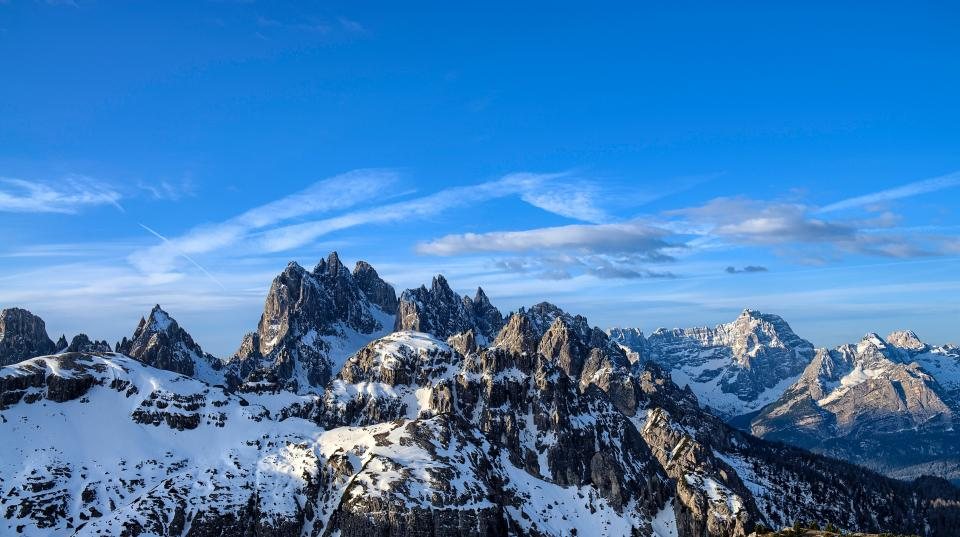
There is no other lift-served ski run quite like it. From the top station of the Aiguille du Midi cable car above Chamonix, the Vallee Blanche descends roughly 20 kilometres (12 miles) of glacier to the Mer de Glace and, in a good snow year, all the way back to the valley floor. It is not steep by off-piste standards, and that is what misleads people. It is a high-mountain glacier route with real crevasses, real exposure and a weather window that can shut in an hour. Skied with the right preparation, it is one of the great days in the Alps.
Up the cable car
The Aiguille du Midi cable car leaves Chamonix at 1,035 metres (3,396 feet) and rises in two stages, with a change at the Plan de l’Aiguille at 2,317 metres (7,602 feet), to a summit station at 3,842 metres (12,605 feet). The second span climbs close to 1,500 metres without a single support pylon, which is worth thinking about on the way up. The whole ride takes around twenty minutes and the altitude gain is a little over 2,800 metres (9,200 feet), so it is normal to feel light-headed and short of breath on arrival. We take our time in the tunnels, get the harness on and the rope out, and drink something before stepping outside.
The top station has a network of tunnels, a viewing terrace facing Mont Blanc, which stands at 4,808 metres (15,774 feet) a few kilometres to the south, and an ice cave that leads out onto the ridge. Early cabins fill quickly on fine days from February onward; booking a slot the day before is standard practice.
The arete
Every Vallee Blanche day begins with the arete, and for many people it is the hardest part. From the ice cave, a narrow snow ridge drops around 60 metres in height over roughly 300 metres of length, with a steep face on the Chamonix side and a drop toward the Vallee Blanche itself on the other. Skis go on the pack, boots go into crampons if the snow is hard, and everyone is roped together. There is usually a fixed handrail rope, and in high season a trench worn into the snow, but the exposure is real and a fall from the ridge is not survivable without the rope. In new snow or strong wind, the arete can be the reason the whole descent is off for the day.
At the bottom of the ridge the ground flattens onto the glacier and skis go on. This is the moment the day changes character, from something nervous to something very wide and very quiet.
Glacier travel
The classic line follows the Glacier du Geant down toward the Requin refuge and onto the Mer de Glace. The gradient rarely exceeds 30 degrees on the standard route, but the ground is a moving glacier and the surface is a bridge of snow over holes that can be 30 metres deep. Crevasse danger changes with the season: in midwinter the bridges are thick and the crevasses hidden; by April the bridges thin and open, and the track weaves around them. The Seracs du Geant, an icefall on the descent, is a place where nobody stops to take photographs.
A rope is not just for the arete. Guides may ski unroped on the well-tracked sections and rope up on flat, suspect ground, and each carries the kit to pull a client out of a hole. A group without a guide should know how to build an anchor in snow, set up a hauling system and get a partner out of a crevasse before they need to. Sticking to the main track is not cowardice: on a glacier, the track is where the ground is known.
The variants, such as the Petit Envers du Plan and the Grand Envers, are steeper and more crevassed and are chosen by conditions and by the group’s skiing, not by ambition.
Down the Mer de Glace
The Mer de Glace is the longest glacier in France, about 7 kilometres long and up to 200 metres thick, moving several dozen metres a year in its faster sections. The lower part is nearly flat and, late in the day, can be heavy or wet, so a tired group with a long push ahead of them is the normal state of affairs. The glacier has lost tens of metres of thickness in recent decades, and the retreat is obvious to anyone who returns after a few years; marker signs on the rock walls show where the ice stood in earlier decades.
The descent ends in one of two ways. In a good snow year, and typically before mid-March, the glacier connects to a forest trail that runs down to the valley floor, giving a total of around 2,800 metres (9,200 feet) of descent. More often, the run finishes at the Montenvers station, at 1,913 metres (6,276 feet). Reaching it means climbing out of the glacier bed: a gondola from near the ice grotto and a set of metal stairways that have grown longer as the ice has dropped, several hundred steps at present. From Montenvers, the rack railway, opened in 1908, takes twenty minutes down to Chamonix.
Season, timing and guides
The Vallee Blanche is skiable from roughly mid-December to May, but the best window for most people is late February to mid-April. Days are longer, the light is better, the snow on the upper glacier is settled and the arete has often been beaten into a comfortable trench. Spring brings its own compromises: the exit to Chamonix is usually closed, the lower glacier turns soft by early afternoon and crevasse bridges are thinner. A start on one of the first cabins gives firm snow and a quiet glacier.
- Take a harness, a transceiver, a probe and a shovel, and know how to use all four.
- Carry crampons and a short rope for the arete, and warm layers for the summit station.
- Check the daily bulletin and the cable car status before leaving the valley.
- Hire a mountain guide unless every person in the group has glacier rescue skills.
A guided day is not an admission of weakness. It is a way of skiing the Vallee Blanche with someone who has crossed it hundreds of times, who knows where the holes are this week and who will make the call to turn back when the cloud comes in. We have done it both ways, and the guided days were the ones we enjoyed most.
Read next: Lookout Pass Ski Area: Powder, Border Skiing and What to Expect