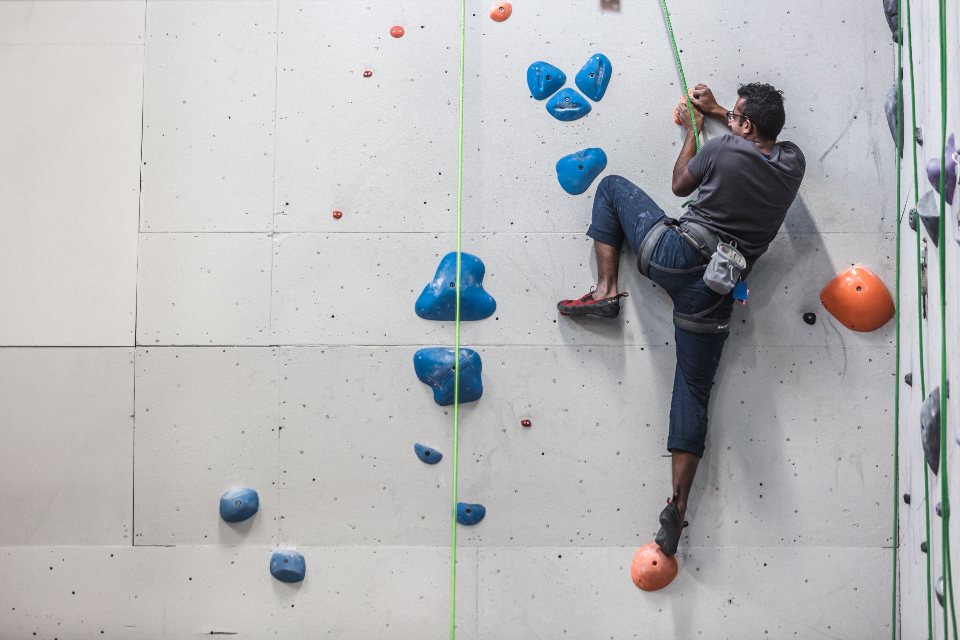
Why Training Smart Matters
Whether you’re scaling granite faces or carving through powder, your body is your most valuable gear. Smart training doesn’t mean training harder—it’s about training better. Understanding your limits, respecting recovery, and building discipline will lead to long-term performance gains and fewer injuries.
Foundations of Strength for Climbers and Skiers
Strength is the backbone of both climbing and skiing. But the type of strength you need varies depending on the sport:
- Climbers benefit from finger, core, and pulling strength.
- Skiers need powerful legs, a stable core, and dynamic balance.
Incorporate exercises like:
- Dead hangs and fingerboard routines (for grip strength)
- Weighted squats and lunges (for lower-body power)
- Planks, Russian twists, and leg raises (for core stability)
Endurance: The Unsung Hero
Long days in the mountains demand more than bursts of strength—they require stamina. Build your aerobic base with:
- Trail running or hiking with elevation gain
- Rowing or cycling for low-impact cardio
- Zone 2 heart rate training to improve fat metabolism
Remember, consistency trumps intensity. 30 minutes a day beats three hours once a week.
Mobility & Recovery: The Missing Links
Pushing your body without proper recovery is a recipe for burnout. Incorporate mobility work and rest into your routine:
- Dynamic stretching before training
- Foam rolling and yoga for post-session recovery
- Sleep and hydration as non-negotiables
Mobility isn’t just about flexibility—it’s about moving with control through full ranges of motion. This reduces injury risk and improves efficiency on rock or snow.
Training Smarter with Periodization
Many athletes plateau because they lack structure. Periodization helps you plan your training across phases:
1. Base Phase
Focus on building aerobic endurance and general strength.
2. Build Phase
Introduce sport-specific training like bouldering circuits or ski touring intervals.
3. Peak Phase
Reduce volume, increase intensity. Prepare body and mind for performance.
4. Recovery Phase
Deload to allow your body to absorb the gains. Essential for long-term progress.
Mindset: The Final Piece
Mental resilience is as crucial as physical readiness. Set clear goals, visualize success, and embrace discomfort. Whether you’re stuck on a crux or navigating a whiteout, a strong mindset can carry you through.
Listen to your body, celebrate small wins, and remember: every session is a step forward.
Hangboard Protocols That Actually Build Fingers
Dead hangs are a fine start, but after a season or two the fingers stop adapting to random hanging. We use three structured protocols and rotate them. The first is repeaters: on a 20 mm edge, hang for 7 seconds, rest for 3 seconds, and repeat six times to make one set of one minute. Rest three minutes between sets, change grip each time (half crimp, open hand, three-finger drag), and stop at six sets. Repeaters build local endurance and are the safest entry into loaded hanging because each hang is short.
The second is max hangs: 10 seconds on the same 20 mm edge with enough added weight, or enough removed through a pulley, that the tenth second is hard but controlled. Five hangs, three minutes of rest between, twice a week at most. This is where pure finger strength comes from and where most people get hurt, so: never hang to failure, and stop the session the moment form breaks. The third is the 7/3 density block, repeaters on a single grip for four to five sets with shorter rests, used in the weeks before a trip when we want the fingers sharp rather than stronger.
Why Tendons Need More Time Than Muscles
Muscle responds to training within weeks. Connective tissue does not. Finger flexor tendons and the pulleys that hold them against the bone remodel over months, not weeks, and the pulleys see very little blood flow, which is why a tweaked A2 pulley takes six to twelve weeks to settle while a sore forearm forgets the session in three days. So hangboard loads should rise far more slowly than the muscles seem to allow. A sensible progression is a 2 to 5 percent increase in added weight every second week, held there for two weeks before the next step, with a full deload every fourth week.
New climbers should give themselves a full year of unstructured climbing before touching a hangboard at all, and even then the first six months should be bodyweight repeaters only. Meaningful tendon adaptation takes roughly 12 to 18 months of consistent loading, slow until you compare it with the two seasons lost to a ruptured pulley. Warm up for fifteen minutes first, and treat sharp pain at the base of a finger as a stop signal.
Ski Legs, Aerobic Zones and the Rest Week
Skiing loads the legs in a way that squats alone do not prepare for: one leg at a time, deep in the knee, and mostly while lengthening under load as the ski decelerates you through each turn. That eccentric, single-leg demand is what burns out quads on day three of a trip. We build it with a short list of movements, six to eight weeks before the first snow, two sessions a week.
- Rear-foot elevated split squats, three sets of eight per leg, lowering for a slow four-count.
- Single-leg box step-downs from a knee-high box, controlling the descent until the heel just touches the floor.
- Eccentric-only leg press or slow Nordic hamstring curls, five to six reps, once a week.
- Lateral hops and skater bounds for the side-to-side stability that moguls and tree skiing demand.
For the aerobic base, heart-rate zones make the vague advice concrete. Zone 1 is a conversational walk, zone 2 sits at roughly 60 to 70 percent of maximum heart rate where you can still speak in full sentences, and zone 3 to 4 is the threshold work you can hold for twenty minutes at most. Ski touring and long alpine approaches live in zone 2, so that is where 80 percent of endurance hours should go: two to four sessions a week of 45 to 90 minutes, with one weekly threshold session of three to four intervals of eight minutes.
Finally, the rest week. Every third or fourth week, cut total volume by 40 to 50 percent while keeping a little intensity so the body does not forget what fast feels like. Fingers, knees and Achilles tendons absorb their gains in these weeks, not the hard ones. Skipping it is the most common reason a good block ends in a strained finger in week nine.
Final Thoughts
Training smart isn’t about chasing exhaustion. It’s about intentional progress, respecting recovery, and staying excited about your journey. Whether you’re clipping bolts or floating down powder, a well-trained body and mind make the experience richer.
Stay consistent, stay curious, and keep reaching higher.