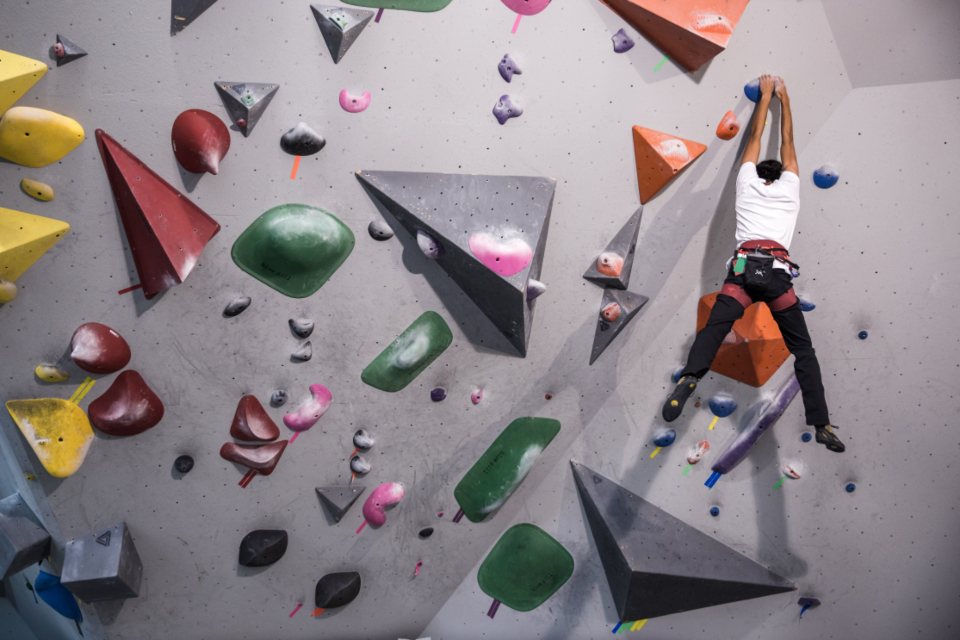
Indoor climbing has produced a generation of strong, technically capable climbers who have never touched real rock. When they do, the first season outside is often humbling: routes that should be easy feel desperate, the rope seems to have a mind of its own, and the moment of lowering off from a bolted anchor turns out to involve decisions nobody explained. Here is what actually changes, and how to make the first season a good one.
Reading the rock, and why grades feel harder
Inside, the holds are coloured, shaped and placed by a setter who wants you to find them. Outside, nothing is marked. Holds are hidden in shadow, footholds are a slight change in texture, and the obvious jug is sometimes a loose flake. Reading rock is a skill that takes weeks to develop and years to refine. Slow down at the base and look at the line before you tie in: where are the cracks, where does the angle change, where would the rests be? On the route, look down for feet far more than you do indoors, and test any hold that sounds hollow when tapped.
The rock type matters. Granite rewards jamming and smearing, limestone gives pockets and edges, sandstone offers rounded features and is fragile when wet.
Nearly everyone drops two or three grades when they go outside. Indoor grading tends to be generous, and indoor routes are set to be climbable: clean holds, consistent movement, clipping positions where you would expect them. Outdoor grades are historical, set by whoever climbed the route first, sometimes decades ago, and they assume you can read rock, place your feet precisely and handle exposure. A route that is technically at your indoor limit will feel much harder when the crux is above a bolt you can barely see and the wind is moving the rope.
Start well below your indoor level, on routes described as popular and well protected, and treat the first ten days as learning rather than performing. The grades come back once the outdoor skills catch up.
Clipping, stances and the lead
On a bolted route outside, the bolt is where the rock allowed it, not where it would be convenient. Sometimes the clip is from a good foothold with a straight arm; sometimes it is from a strenuous position with the bolt at your knee. Learn to find the best clipping stance before you reach the bolt rather than clipping as soon as you see it: often a move higher gives a far better position. Clip with the correct hand, keep the rope in front of your leg, and never clip with the rope running behind your ankle, because a fall in that position flips you upside down.
The first bolt on many routes is high, and a fall before clipping it means the ground. A stick clip, a pole that places the first quickdraw from below, is not cheating; it is standard practice at most sport crags. Above the first clip, clip when the bolt is at chest or waist height, not at full reach.
Lowering, threading and rappelling
At the top of an indoor route there is a pair of carabiners, you clip in and you are lowered. Outside, the anchor may be a chain with rings, two bolts with rap hangers, or nothing but a tree. The standard sequence at a sport anchor is to clip into the anchor with a sling or a tether, pull up slack, pass a bight of rope through the rings, tie a figure-eight on the bight, clip it to the harness with a locker, untie the original knot, pull the rope through, and only then unclip the tether and call for the lower. Practise it on the ground until it is automatic, and always tie a knot in the belayer’s end of the rope so it cannot run through the device if the route is longer than half the rope length.
Some crags require rappelling instead of lowering, either because the anchor is not designed for lowering or because the route continues to a top from which you walk or abseil off. Rappelling is a separate skill with its own checks: rope through both anchor points, both strands through the device, a back-up such as a friction hitch, knots in the ends, and the first person down checking that the rope reaches the next station.
Managing the rope and the belay
Indoor ropes are fixed and tidy. Outside, you carry your own, and it will find every stone, root and hole in the ground. Flake it into a rope bag or onto a tarp at the base, with the belayer’s end on top, and tie the tail into the bag or to the belayer. Keep the rope out of the dirt, since grit inside the sheath wears the rope and the belay device.
The belayer’s job also grows outside. Wandering routes and ledges mean a leader can hit something in a fall that does not exist indoors, so the belayer gives slack more precisely and pays attention to the leader’s position relative to the ground and the first bolts. Stand close to the base, wear a helmet, and watch the leader rather than the view.
Helmets, weather and leaving no trace
Wear a helmet. Rock falls from above, quickdraws get dropped, and a lead fall can turn you into the wall head first. Check the weather and the aspect of the crag: sun, wind and temperature decide whether a day is pleasant or miserable, and rain on some rock types ends the day for safety reasons, not just comfort.
Crags are shared with landowners, walkers, nesting birds and the next generation of climbers. Pack out all rubbish including finger tape, use toilets before the walk in and bury or carry out waste where there are none, keep noise down, park where you are asked, and stay on the paths.
Mentors, courses and the long game
The fastest way through the first season is company. Find an experienced partner who is willing to explain rather than just lead, and offer something in return: enthusiasm, belaying, driving. Join a club if one exists locally; most welcome newcomers and run beginner days. A course with a qualified instructor covers anchors, lowering, rappelling and rescue basics in a weekend and removes the guesswork from the skills that matter most. Read the guidebook for the crag, ask questions at the base, and be honest about what you do not know. Outdoor climbing rewards humility, and the climbers who have been at it for decades still say they are learning.