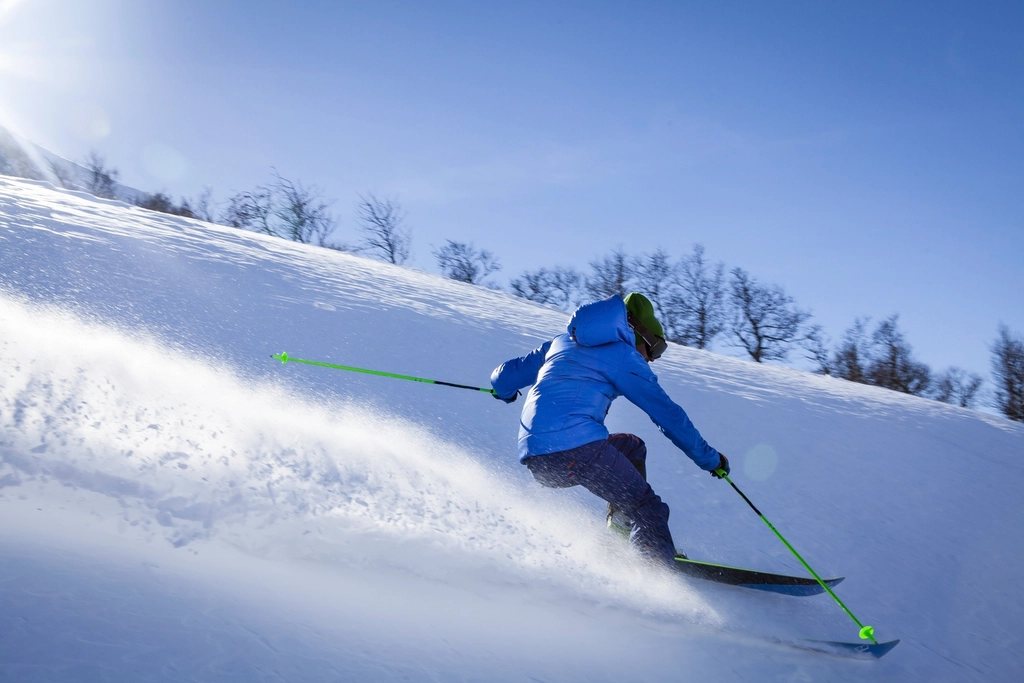
Little Cottonwood Canyon is a glacial trough about 13 kilometres (8 miles) long, cut into the Wasatch Range immediately south-east of Salt Lake City. It holds two ski areas, a two-lane state highway and more than 60 avalanche paths that cross that highway, and it collects more snow than almost any other lift-served mountain in North America. The reasons for that, and the way the canyon runs itself around the snow, are worth understanding before a visit.
Why it snows so much
The upper canyon averages around 500 inches (12.7 metres) of snow a season, and the record winter of 2022-23 delivered more than 900 inches (22.9 metres). Three things combine. Pacific storms cross the Great Basin, arriving relatively cold and dry after a long run over desert, and lift sharply against the Wasatch, which rises about 2,000 metres (7,000 feet) above the valley within a few kilometres. The canyon’s shape adds to that orographic lift: a narrow east-west trench that funnels north-west flow straight up to its head, where the storms stack against the high ridge.
The third factor is the Great Salt Lake, about 40 kilometres (25 miles) to the north-west. When cold air crosses the relatively warm, unfrozen lake, it picks up moisture and instability and dumps it on the mountains downwind. Research on the Wasatch suggests lake-effect snow is responsible for something like 5 to 10 percent of the seasonal total, less than local legend claims but enough to turn a good storm into a memorable one. It is most active in early winter, when the lake is warmest relative to the air.
The snow that results is cold and light, averaging around 8 to 9 percent water content, and it comes in storm cycles of two to four days that can drop 60 to 100 centimetres (two to three feet) in a single push.
The canyon road
The highway up the canyon, State Route 210, climbs from about 1,650 metres (5,400 feet) at the mouth to 2,600 metres (8,500 feet) at the top, and its entire upper half runs beneath steep, open avalanche paths that release naturally in big storms. It is one of the most avalanche-exposed public roads in the country. The state transportation department fires explosives into the starting zones by artillery, remote gas exploders and helicopter, and closes the road whenever paths are likely to run.
Closures follow a pattern. The road shuts before or during a storm cycle, sometimes overnight, sometimes for a day or more; crews carry out control work at first light; and the road reopens once the paths have been shot and the debris cleared. On the biggest days a queue of cars waits at the canyon mouth for the gates to open, and the first hour after an overnight closure is the reason people put up with it. A traction law applies in storms: four-wheel or all-wheel drive with proper tyres, or chains.
Interlodge
When the avalanche hazard to the buildings at the top of the canyon is high enough, the local authorities declare an interlodge. Everyone inside the lodges and homes at the top stays inside, doors locked, until the control work is done and the order is lifted. It can last a few hours or, in a major cycle, more than a day, and it is enforced, because the buildings at the canyon head sit within the runout of large paths and the control work itself sends debris across roads and car parks. It is a strange experience, a lodge full of people and a metre of new snow outside that nobody may touch, and it is the preamble to the deepest skiing of the year.
Resort versus backcountry
The two resorts occupy the head of the canyon: one at the very top, founded in 1938 and still closed to snowboards, with a base of about 2,600 metres (8,530 feet) and lifts to around 3,200 metres (10,500 feet); and one just below it, opened in 1971, with a tram to a summit at about 3,350 metres (11,000 feet). Inside the ropes, the ski patrols control some of the steepest lift-served terrain in the country every storm morning. Outside the ropes is a different world with the same snow.
The Wasatch backcountry around Little Cottonwood is famously accessible: the ridgelines above both resorts lead directly into drainages like Grizzly Gulch and White Pine, and the peaks across the canyon, topping out just over 3,350 metres (11,000 feet), are skied from the road. That accessibility, combined with slopes of 35 to 45 degrees and a snowpack that is often loaded and wind-affected in the days after a storm, produces a steady toll. Skiers leaving through a backcountry gate are on their own the moment they pass it, in terrain that has not been controlled.
- Read the regional avalanche forecast every morning; it is issued at dawn and is exceptionally detailed.
- Carry a transceiver, probe and shovel, and travel with people who can use them.
- Treat the first two days after a storm cycle as the most dangerous, not the most inviting.
- Remember that road closures and interlodge apply to backcountry skiers too.
Reading a storm cycle
The rhythm of a Wasatch winter is the storm cycle. A front arrives from the north-west, the road closes, snow falls for two or three days, and the first clear morning is a race for untracked snow both inside and outside the resorts. In the backcountry, that first clear morning is often the worst day of the week for avalanches: new snow on old surfaces, wind slabs on the lee sides of every ridge, and a crowd. The following days are better for touring, and by the fourth or fifth day the snowpack has usually settled. Persistent weak layers are less common here than in the drier ranges to the east, but in low-snow early winters a faceted base can linger into January.
Season length is generous. Lifts typically run from late November to mid-April, and the upper resort often extends into May on a base that can still exceed 3 metres (10 feet). For touring, March and April are the sweet spot: a deep, settled snowpack, long days and, on the north faces above 3,000 metres (9,800 feet), cold snow well into spring.
Getting there and getting out
The canyon mouth is about 40 minutes by road from the Salt Lake City airport, which makes it possible to fly in on a storm morning and be skiing by lunch. The same proximity is why the road is so crowded: more than a million people live within an hour of it. On a powder day we leave early, accept the queue and plan around the road status rather than the lift schedule. The canyon decides when the day starts. Once it does, the snow is the deepest and the lightest we have skied anywhere with a lift under it.