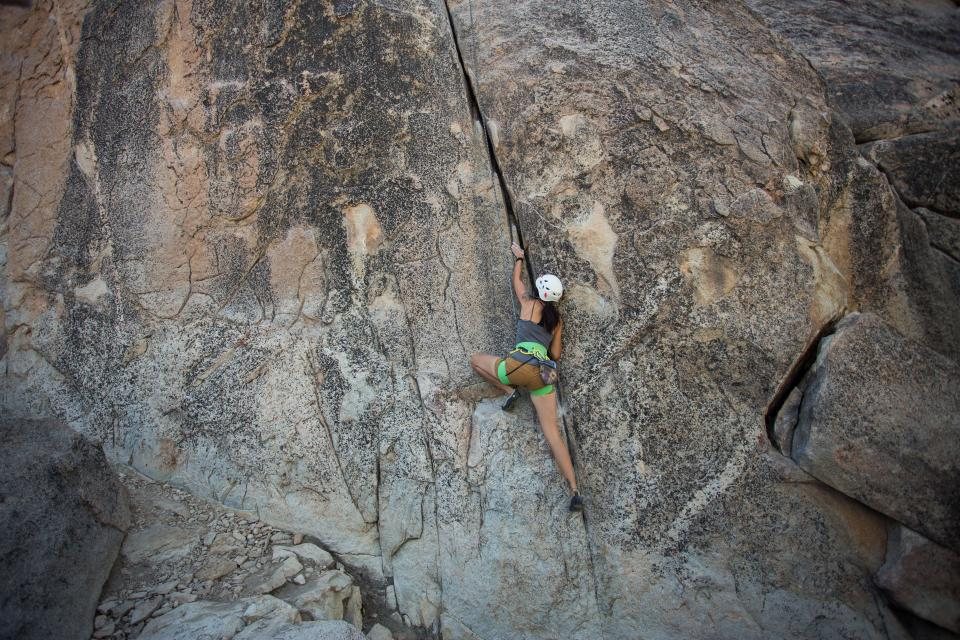
The difference between a team that climbs a ten-pitch route in six hours and a team that climbs the same route in eleven is rarely fitness or grade. It is the time spent not climbing: at belays, untangling ropes, shouting into the wind, deciding who goes next. Multi-pitch efficiency is a set of small habits that add up to hours of daylight, and daylight is the resource that decides whether a big route ends with dinner or with a headtorch and a cold night.
Swinging leads or block leading
There are two ways to share the leading. Swinging leads means alternating: one person leads a pitch, brings up the second, who then leads through on the next pitch while the first belays. Block leading means one person leads several pitches in a row, or the whole route, while the partner follows every pitch.
Swinging leads feels natural and shares the work, and it is efficient in one specific way: the second arrives at the belay with the rack already on their harness and simply carries on, with no gear swap. It works best when both climbers are comfortable leading every pitch. Block leading is faster when one climber is noticeably stronger or when the pitches are all of one kind, because the leader gets into a rhythm and the follower can focus on cleaning quickly. Decide before you leave the ground, and change the plan only at a belay.
The two-minute belay transition
A belay changeover can take two minutes or fifteen, and the same team can do both on the same day. The fast version has a fixed sequence, repeated at every stance until it is automatic:
- The leader reaches the anchor, builds or clips it, ties in with a clove hitch and immediately calls off belay.
- While the leader pulls up slack, the second strips the belay, checks the stance is clean and gets ready to climb.
- The leader puts the second on belay directly from the anchor and calls climbing when ready; the second climbs and cleans gear straight onto a gear sling or a single loop, not scattered over the harness.
- At the stance, the second clips in with a clove hitch, hands over the rack in one movement, and the next leader re-racks while the belayer restacks the rope.
- The next leader clips a first piece from the anchor, the belayer confirms the belay, and the leader goes.
The two habits that save the most time are the clove hitch to the anchor, which is fast to adjust and fast to undo, and the practice of racking in a fixed order so that the handover is a transfer rather than a sort.
Rope management on the stance
Most lost time at belays comes from rope. The rope arrives in a pile with the leader’s end at the bottom, which is exactly wrong for the next pitch. The solution is to stack deliberately as you belay the second: lap the rope back and forth over a leg, a sling clipped to the anchor, or the tie-in strands so that it forms neat loops from long to short. When the second arrives and takes over the lead, the rope needs to be flipped so their end is on top; if you have stacked over a sling, you can simply unclip and reclip it to the other side, or the new belayer can restack from the top down while the leader re-racks.
On hanging belays or in high wind, keep the rope short and controlled. Never let the rope hang free below a ledge where it can snag on a flake or blow around a corner; a stuck rope on pitch six can cost an hour.
Talking when you cannot hear
Wind, distance and a bulging wall turn shouting into guesswork, and misunderstood calls are behind a good number of accidents. Agree the system on the ground. Use as few words as possible and put the partner’s name in front of each call so nobody responds to the party on the next route. When voices fail, use rope signals: three sharp tugs from the leader means off belay, three from the second means climbing, and the number and pattern must be agreed beforehand.
Small two-way radios have become common on long routes and remove most of the ambiguity, but they fail, run flat and get dropped. Treat them as a convenience and keep the rope-signal system as the fallback that both climbers actually know.
The rule of thirds and the turnaround time
Before setting off, divide the available daylight into three. One third is for the climb, one third for the descent and the walk out, and one third is reserve for the things that go wrong: a stuck rope, a route-finding error, a slower partner. If you have twelve hours of light and the approach is done by seven, the climb should be finished by eleven, the descent by three, and the extra hours are yours to spend on mistakes. Most teams that end up benighted planned for two thirds and used the third they did not have.
From that budget, set a turnaround time and write it down, or say it out loud. If at that hour you are not at a point from which the descent is straightforward, you go down, regardless of how close the top looks. Pitch counts and route lengths tell you where you are; a headtorch and an emergency layer in each pack tell you how much the turnaround time can bend.
Retreating and bail anchors
Going down from the middle of a route is not a failure, but it is a skill, and it is worth practising before the day you need it. Retreat usually means rappelling from whatever anchors exist. On popular routes there are often fixed stations; on others you will leave gear. A bail anchor should follow the same principles as any other: two solid pieces at least, connected so that the rope runs through a link or a sling you are prepared to lose, never directly through a sling in a way that can melt it. Nuts are cheaper to leave than cams; a single old piton is never enough on its own.
Before each rappel, tie knots in both rope ends, check that the rope reaches the next station or the ground, and identify the next anchor before pulling. Pull tests while the first person is still at the station cost seconds and save stuck ropes. Retreating well is a mark of a competent team, and the route will be there next season.