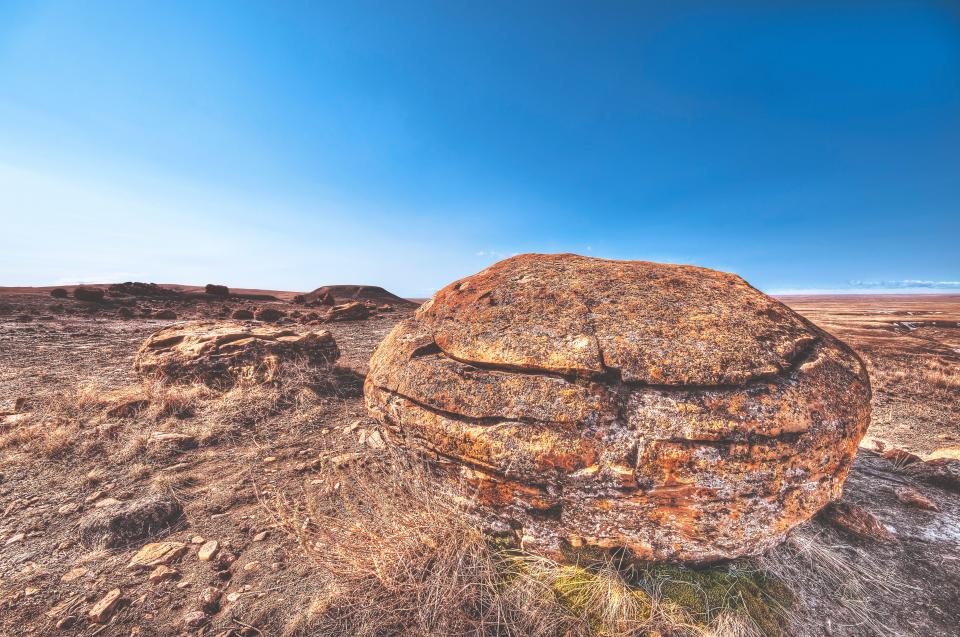
When the northern summer turns the sandstone of Europe into a hot, humid mess, a good part of the bouldering world packs its pads and flies south. Rocklands, in the Cederberg mountains of South Africa’s Western Cape, has become the great winter destination of the southern hemisphere: two or three months of cold, dry air, orange rock and more problems than anyone could climb in a lifetime. We have made the trip several times, and what follows is what we wish someone had told us before the first one.
Where it is and what the rock is
Rocklands lies roughly 250 kilometres north of Cape Town, a three-hour drive up the west coast and inland to the small town of Clanwilliam, then up a winding pass into the mountains. The Cederberg is a wilderness of sandstone belonging to the Table Mountain Group, laid down as river and shallow-sea sand around 450 million years ago and later folded and lifted. It weathers into orange, red and purple walls streaked with black, sculpted into overhangs, huecos and improbable rounded fins.
The rock is hard, quartz-rich and extraordinarily grippy, with a crystalline texture that is kind on friction and unkind on skin. Holds are often sharp-edged crimps, sloping rails and sandstone pockets, and the boulders tend to be steep. The classic Rocklands problem starts under a roof or a bulge, climbs on positive holds through the steepness, and then finishes on slopers or a committing top-out high above the pads. Grades use the Fontainebleau scale, and there are worthwhile problems at every level from 4 to the top of the scale.
June to August: the winter season
The Cederberg has a Mediterranean climate: hot, dry summers and cool, wet winters. That sounds like the wrong way round for climbers, but the rain comes in fronts that pass through in a day or two and leave long clear spells behind, and the winter sun is gentle enough to climb in all day. From June to August, daytime highs run between about 12 and 20 degrees Celsius, and the air is dry between fronts. May and September are shoulder months that work well for anyone who dislikes crowds and can accept a few warm afternoons.
Nights are cold. At around 700 to 1,000 metres of altitude, clear winter nights routinely fall below freezing, and frost on the tent is normal in July. Mornings can start with numb fingers on frozen sandstone; by mid-morning the sun has warmed the east-facing walls and the day begins. The sun then moves round the boulders, so most people follow the shade in the afternoon, and the sunny side of a boulder in August can be genuinely hot to the touch even when the air is cool. Heat is a real factor on the exposed plateau areas; a hat, sun protection and water matter as much as they would in a desert.
Farm land, park land and permits
The boulders are spread across two kinds of land, and the access rules differ. Some areas sit inside a provincial nature reserve managed by the regional conservation authority. Others are on private working farms whose owners have opened their land to climbers in exchange for a fee. Neither is a free-for-all. The reserve requires a daily or seasonal permit bought at the reserve office or through the conservation authority’s annual card; the farms sell their own passes, usually as a day, week or season permit at the farm office or campsite reception.
The farms are the reason Rocklands works at all, and the relationship is fragile. Access has been withdrawn from individual areas in the past because of littering, gates left open, fires and climbers wandering onto ground that was never opened. We buy the permit before we walk in, we keep to the marked paths, we close every gate we open and we never assume that an area we climbed in a previous year is still available. Rules change from season to season, and the campsite reception or the reserve office is where you find out.
The Pass, Roadcrew and the shape of a week
Most visitors orient themselves around the pass that carries the main road over the mountains. The area simply called the Pass is the historic core, a mixture of steep, hard classics and long circuits of moderate problems on either side of the road, with easy parking and a short walk. Roadcrew sits just above the road on the same stretch: a compact cluster of roofs, caves and prow lines where the afternoon shade arrives early and the harder problems draw a crowd. Beyond the road are the plateau areas, higher and more exposed, reached by a walk of twenty to forty minutes, and the riverside areas below, sheltered and greener.
A typical week looks like this: two days on, one day off, repeated. The rock eats skin. Even people who climb five days a week at home find that three consecutive days on Rocklands crimps leaves fingertips too thin to hold anything. Rest days are for the river, the village bakery in Clanwilliam and the strange, quiet business of doing nothing while the sun moves across a mountain.
Camping, cottages and self-catering
There are no hotels in the boulders. Accommodation is either camping or self-catering, and both are simple. The campsites, run by the farms and by the reserve, offer flat pitches, shared ablution blocks with hot water, and usually a communal kitchen or braai area. Self-catering cottages and chalets on the farms range from basic to comfortable and book out months in advance for July. Whatever you choose, expect to cook for yourself, to bring a torch and a warm sleeping bag, and to share the evening with climbers from a dozen countries around a fire.
Clanwilliam has supermarkets, a fuel station, a pharmacy and a couple of restaurants, and is about half an hour from most areas, so a car is close to essential. Shopping is done in bulk every few days. Mobile signal is patchy in the boulders and better in the village, which most of us treat as a feature.
Living with the mountains
The Cederberg is a real wilderness with a real ecology. The fynbos vegetation is slow-growing and fire-prone; it must not be trampled, cut for pad placement or, ever, exposed to a stray spark. Baboon troops move through the boulders and will empty an unattended pack in seconds. Puff adders and other snakes are present and become more active on warm days, so we watch where we put our hands at the base of a boulder and our feet on the descent. There is one general rule that covers all of it: leave the place as you found it, or slightly better. A long winter of good bouldering depends on the farmers, the reserve and the mountains all being willing to have us back.